
Christmas Exhibition - Tangentyere Artists and Yarrenyty Arltere Artists Figurative and Non-Figurative
We are staying strong, helping each other, staying strong together. Our painting helps us be strong.
Want to purchase an artwork? Drop us a line at arts@tangentyere.org.au with the title, #number and artist name.
Please note that these prices are exclusive of stretching and shipping. We send paintings rolled and with Australia Post, sign on delivery. Paintings wider than 84cm are sent with TNT. When we send your artwork with either company we will email you the tracking number.
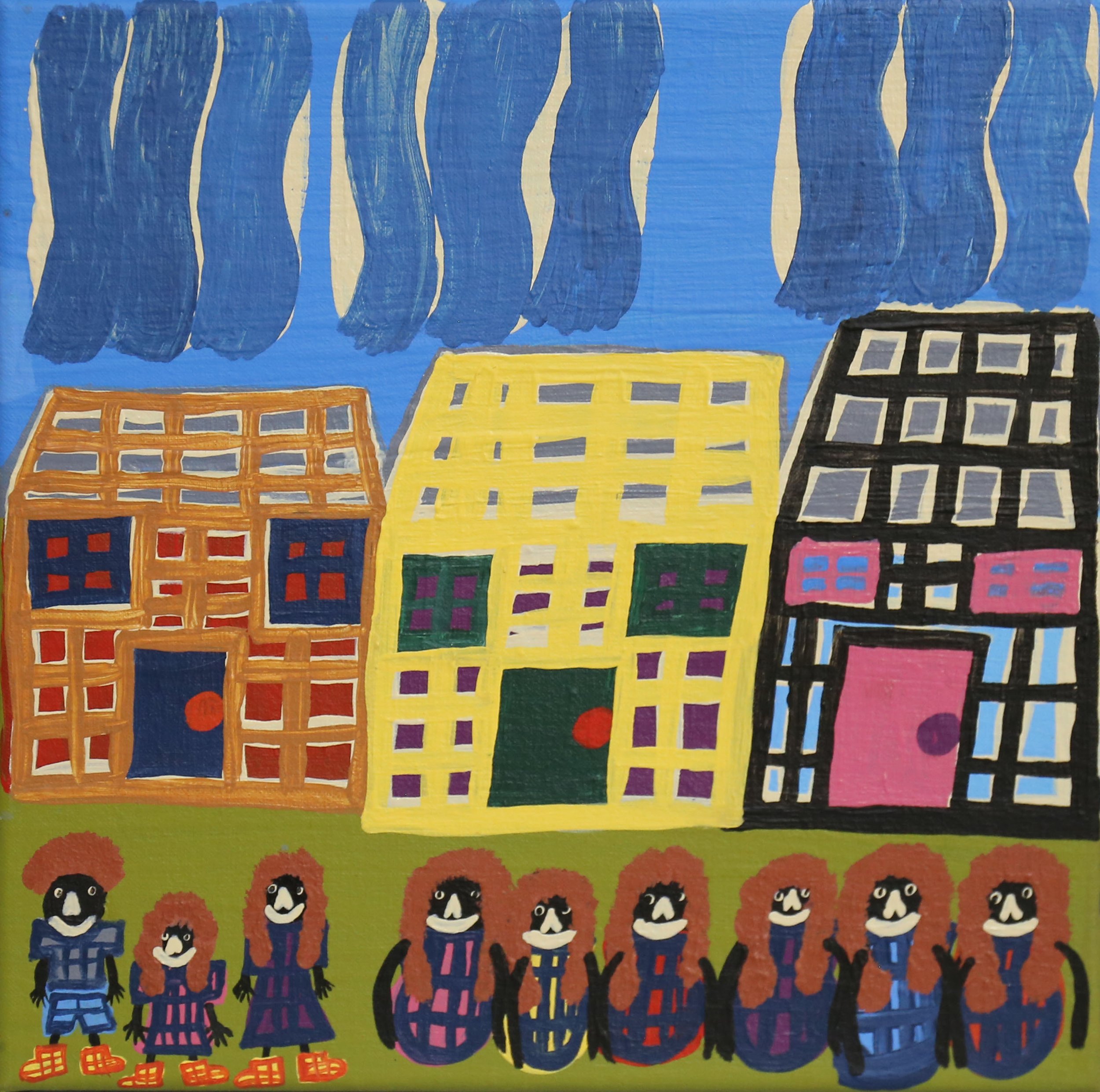
Ingrid Williams / Three houses in Hermannsburg, 2025 #14259-25
30.5 cm x 30.5 cm Acrylic on Linen
'Three houses in Hermannsburg, family houses at Sandhill Camp. That's like our family area at Hermannsburg. The families are sitting down outside watching tourist cars coming to Alice Springs.'
$200 on stretcher
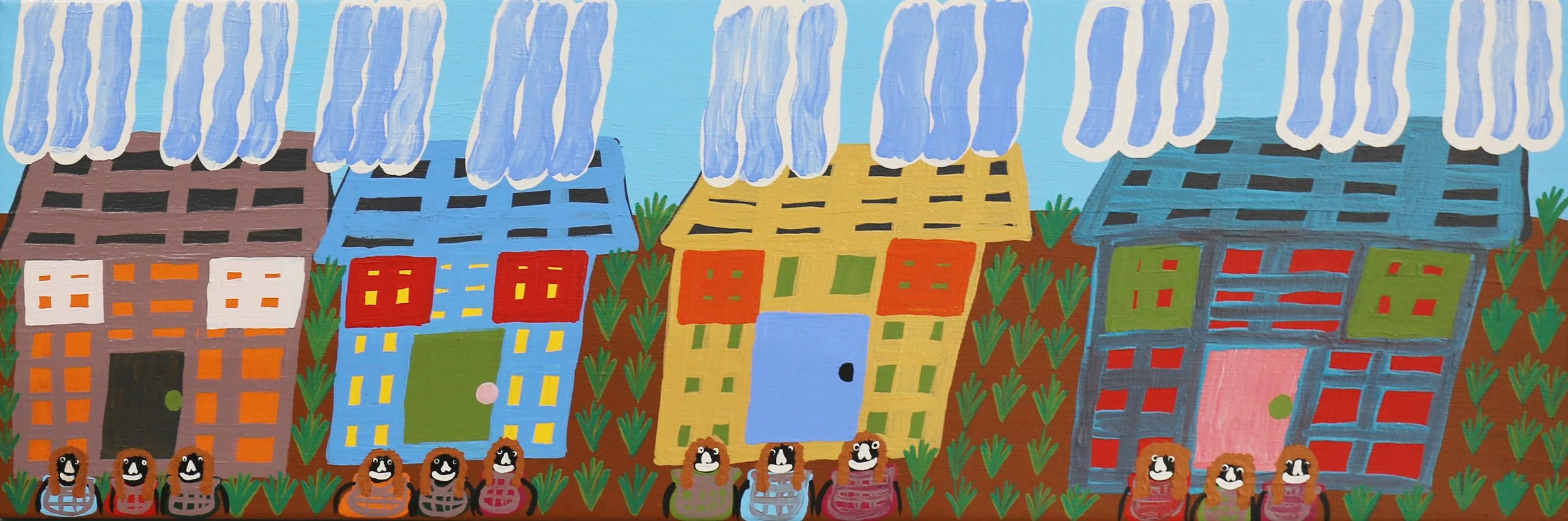
Ingrid Williams / Houses in Hermannsburg, 2025 #14184-25
29.5 cm x 910 cm Acrylic on Linen
'Houses in Hermannsburg, family houses at Sandhill Camp. That's like our family area at Hermannsburg. The families are sitting down outside watching tourist cars coming to Alice Springs.'
$400
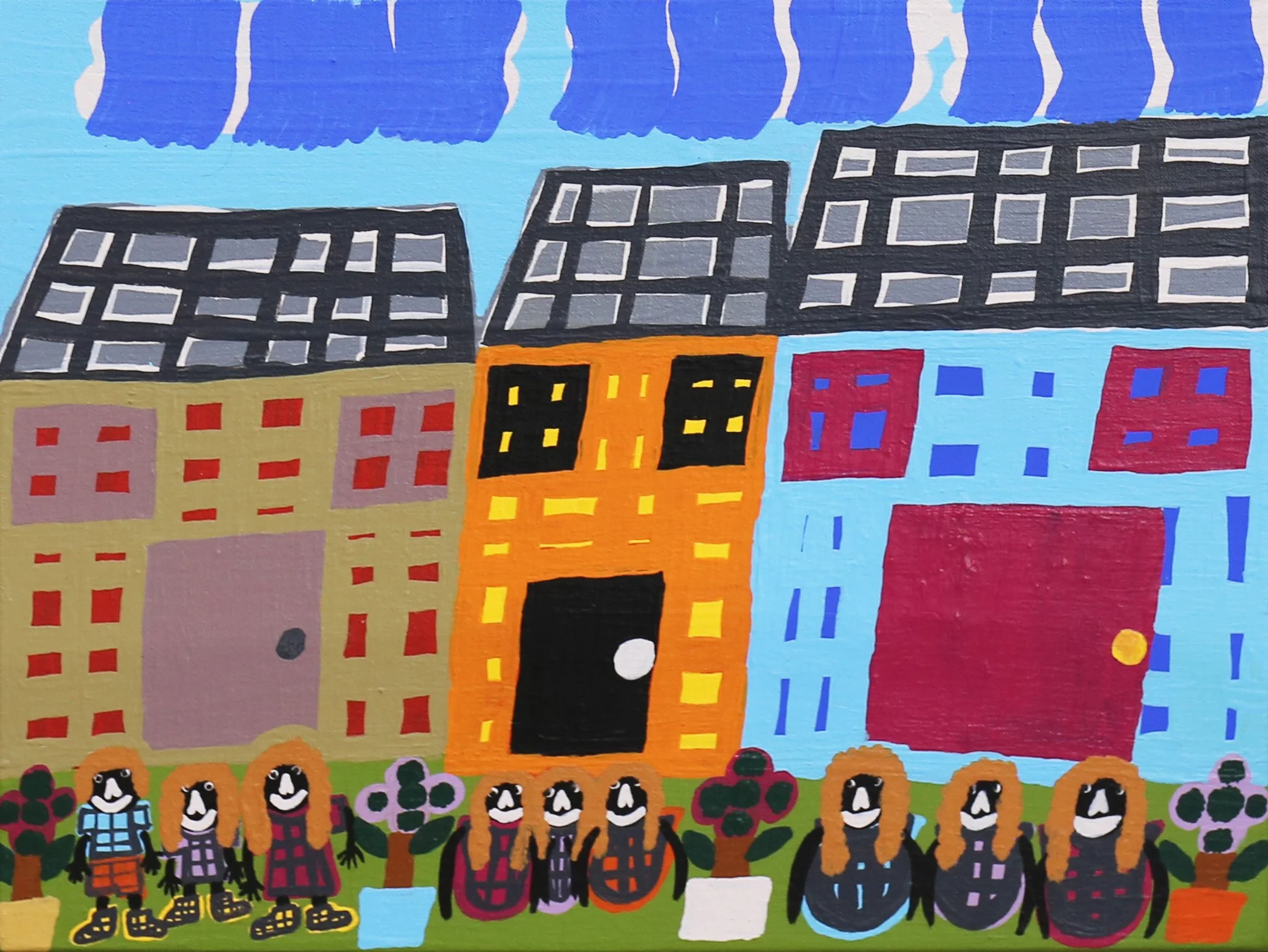
Ingrid Williams / Three Houses in Hermannsburg, 2025 #14169-25
30.5 cm x 40.5 cm Acrylic on Linen
'Three houses in Hermannsburg, family houses at Sandhill Camp. That's like our family area at Hermannsburg. The families are sitting down outside watching tourist cars coming to Alice Springs.'
$220 on stretcher
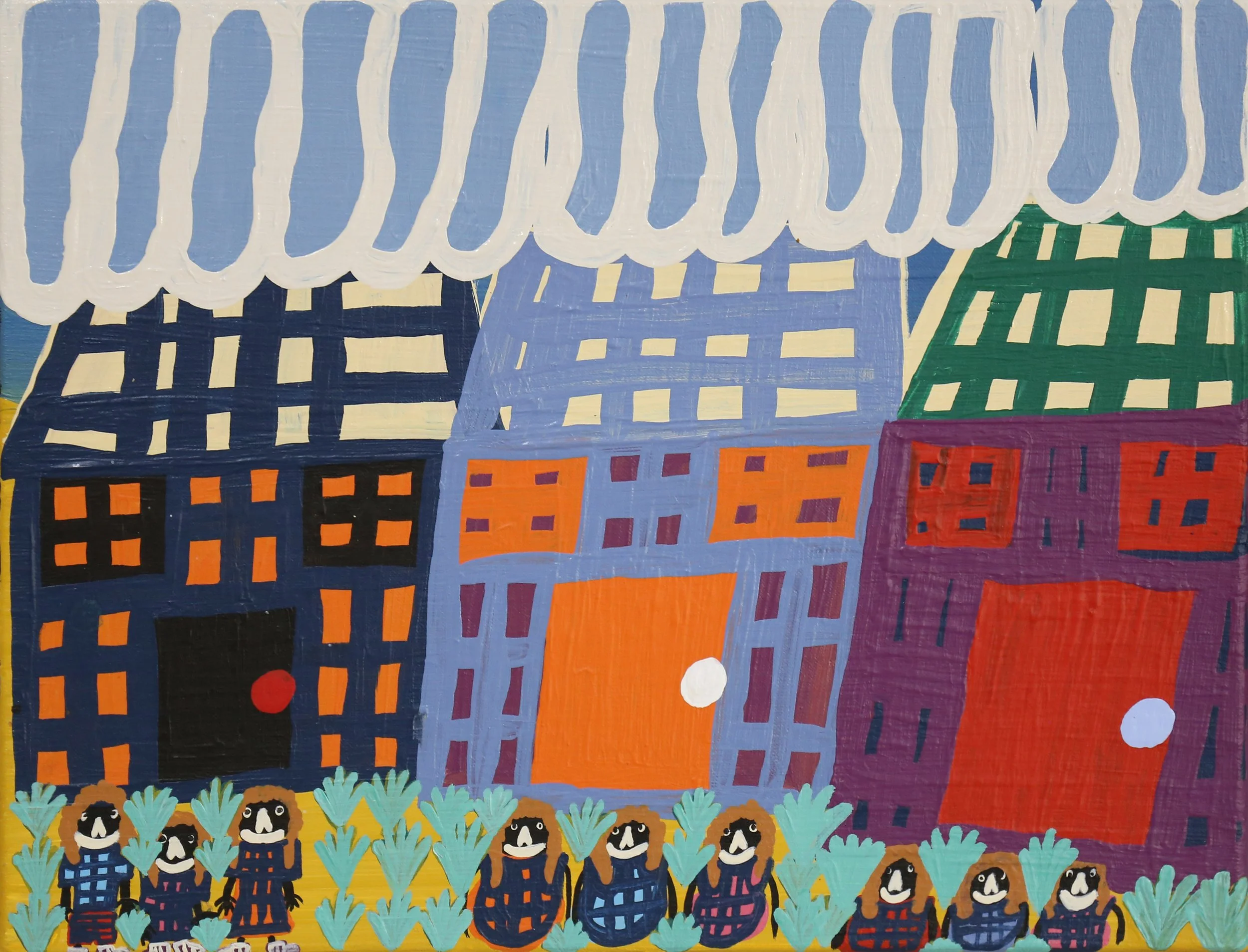
Ingrid Williams / Three Houses in Hermannsburg, 2025 #14258-25
30.5 cm x 40.5 cm Acrylic on Linen
'Three houses in Hermannsburg, family houses at Sandhill Camp. That's like our family area at Hermannsburg. The families are sitting down outside watching tourist cars coming to Alice Springs.'
$220 on stretcher
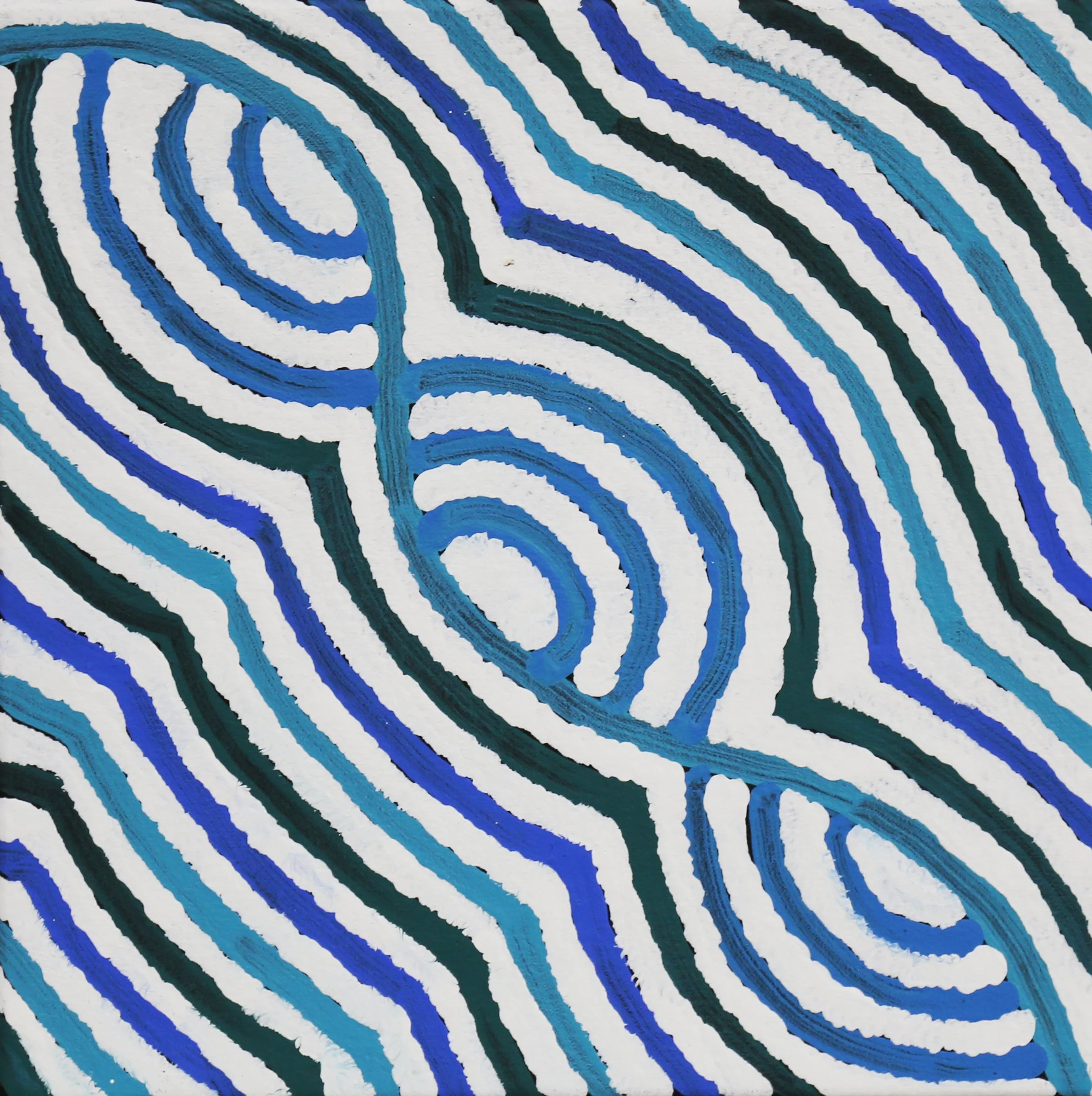
Rosequinne ‘Oki’ Nuggett / Tali (Sandhill), 2025 #14213-25
30.5 cm x 30.5 cm Acrylic on Linen
‘Tali (Sandhills) at Mutijulu. my Grandfather's country is Mutijulu, community close to Uluru, where I have painted these Tali (Sandhills). Tali is everywhere around there, vibrant orange and red. Lots of native flowers growing on the Tali.’
$220 on stretcher
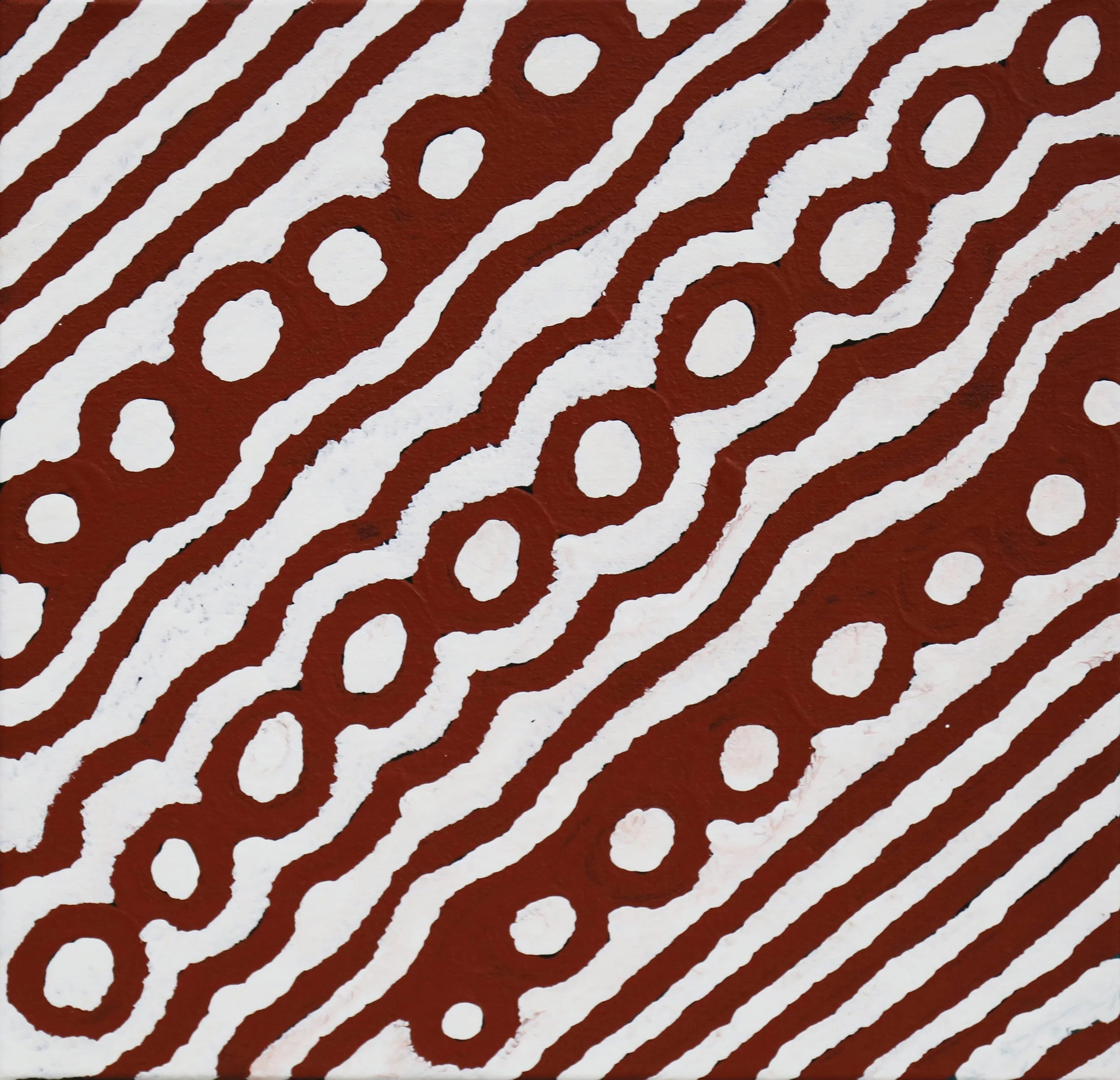
Rosequinne ‘Oki’ Nuggett / Tali (Sandhill), 2025 #14212-25
30.5 cm x 30.5 cm Acrylic on Linen
‘Tali (Sandhills) at Mutijulu. my Grandfather's country is Mutijulu, community close to Uluru, where I have painted these Tali (Sandhills). Tali is everywhere around there, vibrant orange and red. Lots of native flowers growing on the Tali.’
$220 on stretcher
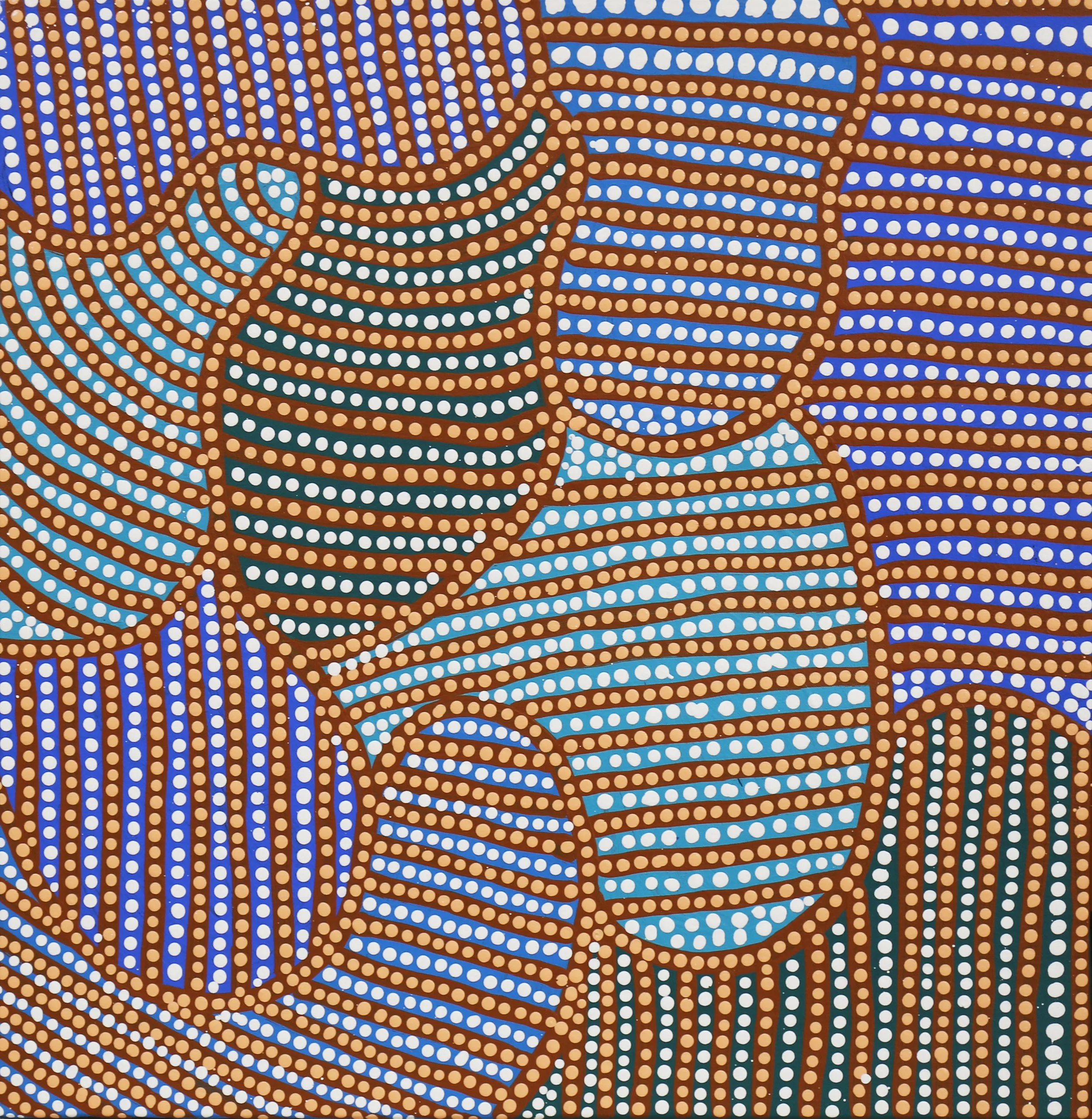
Rosequinne ‘Oki’ Nuggett / Tali (Sandhill), 2025 #14214-25
56 cm x 56 cm Acrylic on Linen
‘Tali (Sandhills) at Mutijulu. my Grandfather's country is Mutijulu, community close to Uluru, where I have painted these Tali (Sandhills). Tali is everywhere around there, vibrant orange and red. Lots of native flowers growing on the Tali.’
$500
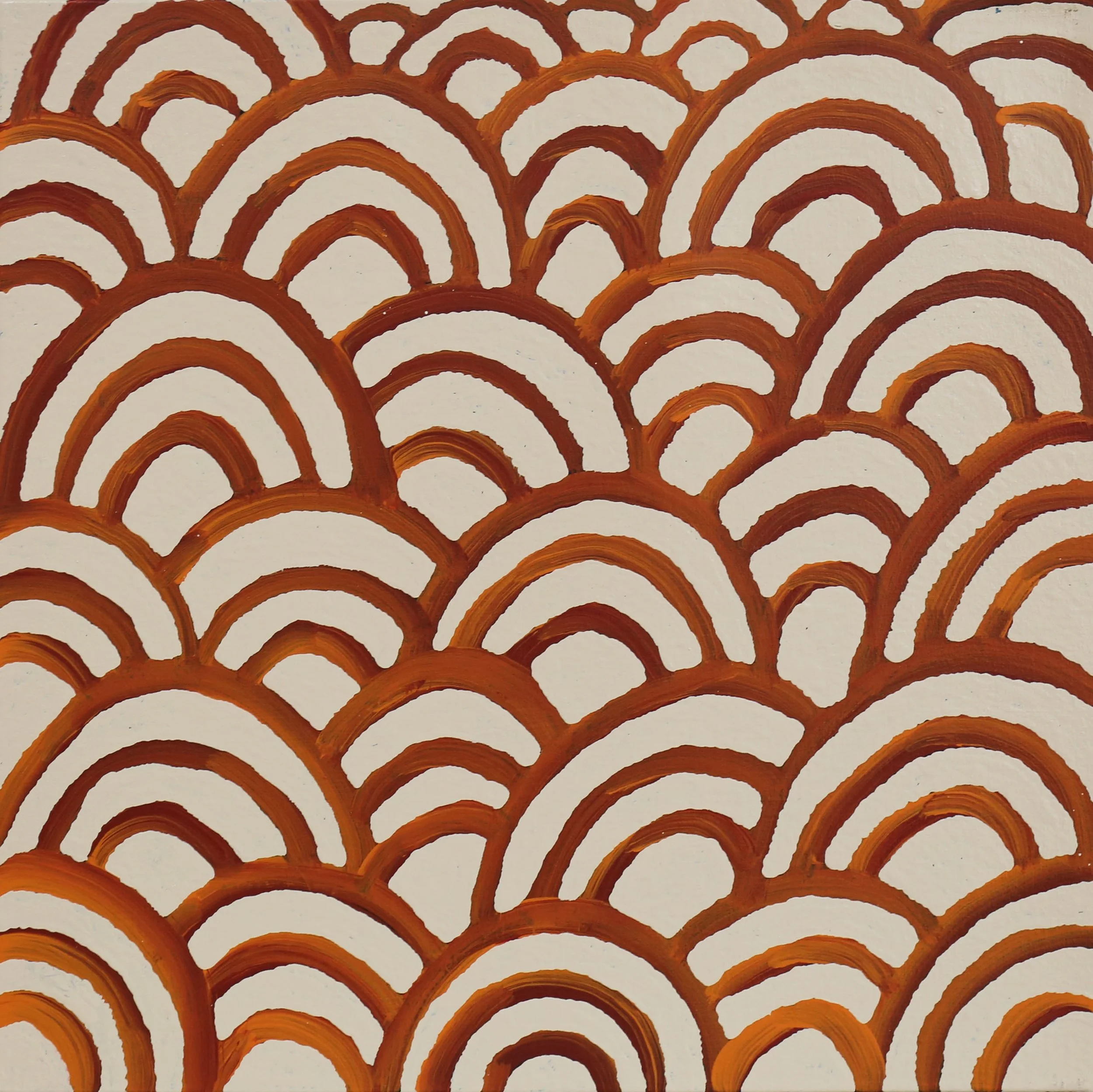
Rosequinne ‘Oki’ Nuggett / Tali (Sandhill), 2025 #14264-25
56 cm x 56 cm Acrylic on Linen
‘Tali (Sandhills) at Mutijulu. my Grandfather's country is Mutijulu, community close to Uluru, where I have painted these Tali (Sandhills). Tali is everywhere around there, vibrant orange and red. Lots of native flowers growing on the Tali.’
$500

Rosequinne ‘Oki’ Nuggett / Minyma Kutjara (Two Sisters), 2025 #14261-25
40.5 cm x 40.5 cm Acrylic on Linen
The Minyma Kutjara (Two Women) story is a significant creation story for Aboriginal people, particularly in the Western and Southern deserts, and is deeply connected to Mutitjulu. It tells of two sisters on a long journey who shaped the landscape as they travelled, creating sacred sites, rockholes, and mountains, and leaving behind knowledge for women's business.
$260 on stretcher
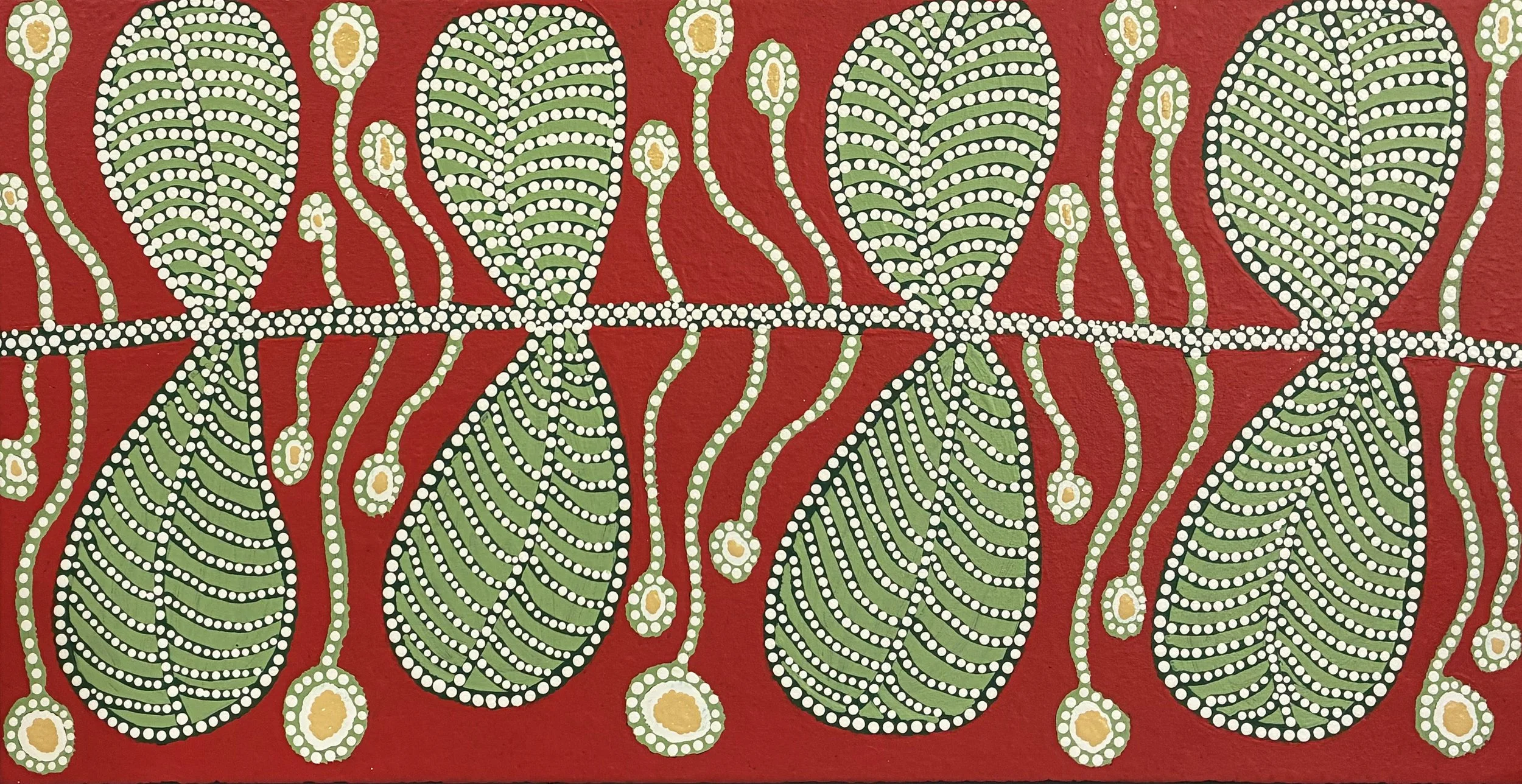
Rosequinne ‘Oki’ Nuggett / Minkulpa (bush tobacco), 2025 #14241-25
46 cm x 90 cm Acrylic on Linen
Minkulpa (bush tobacco) plant growing, the leaves are ready to pick, dry them out and then they are ready. Lots of minkulpa growing after the rain.
$650

Rosequinne ‘Oki’ Nuggett / Minkulpa (bush tobacco), 2025 #14136-25
60 cm x 107 cm Acrylic on Linen
Minkulpa (bush tobacco) plant growing, the leaves are ready to pick, dry them out and then they are ready. Lots of minkulpa growing after the rain.
$1,200
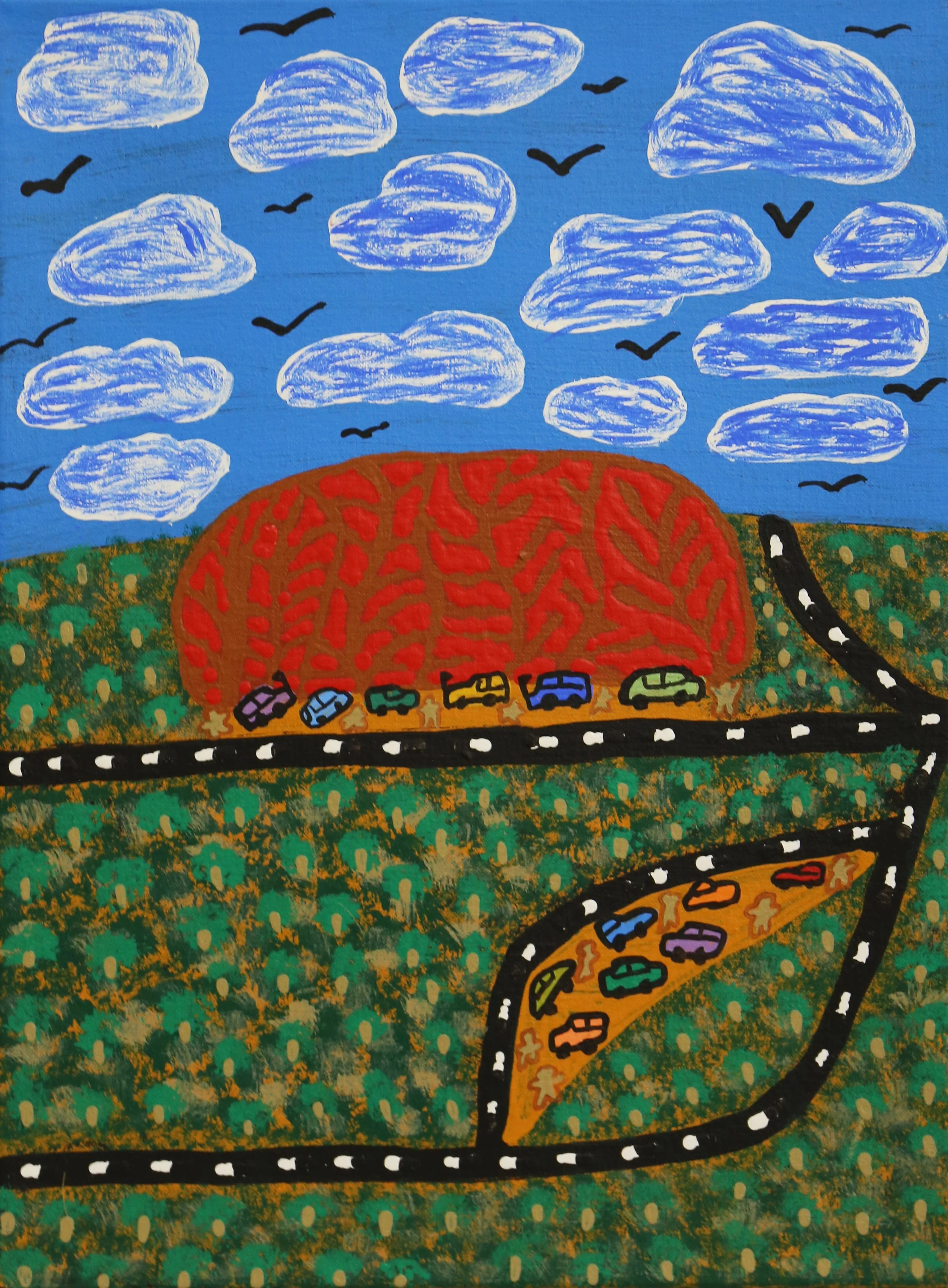
Rosequinne ‘Oki’ Nuggett / Tourists visiting Uluru, 2025 #14257-25
30.5 cm x 41 cm Acrylic on Linen
Tourists visiting Uluru, looking at Uluru, driving around. Anangu driving past going to Mutijulu.
$220 on stretcher
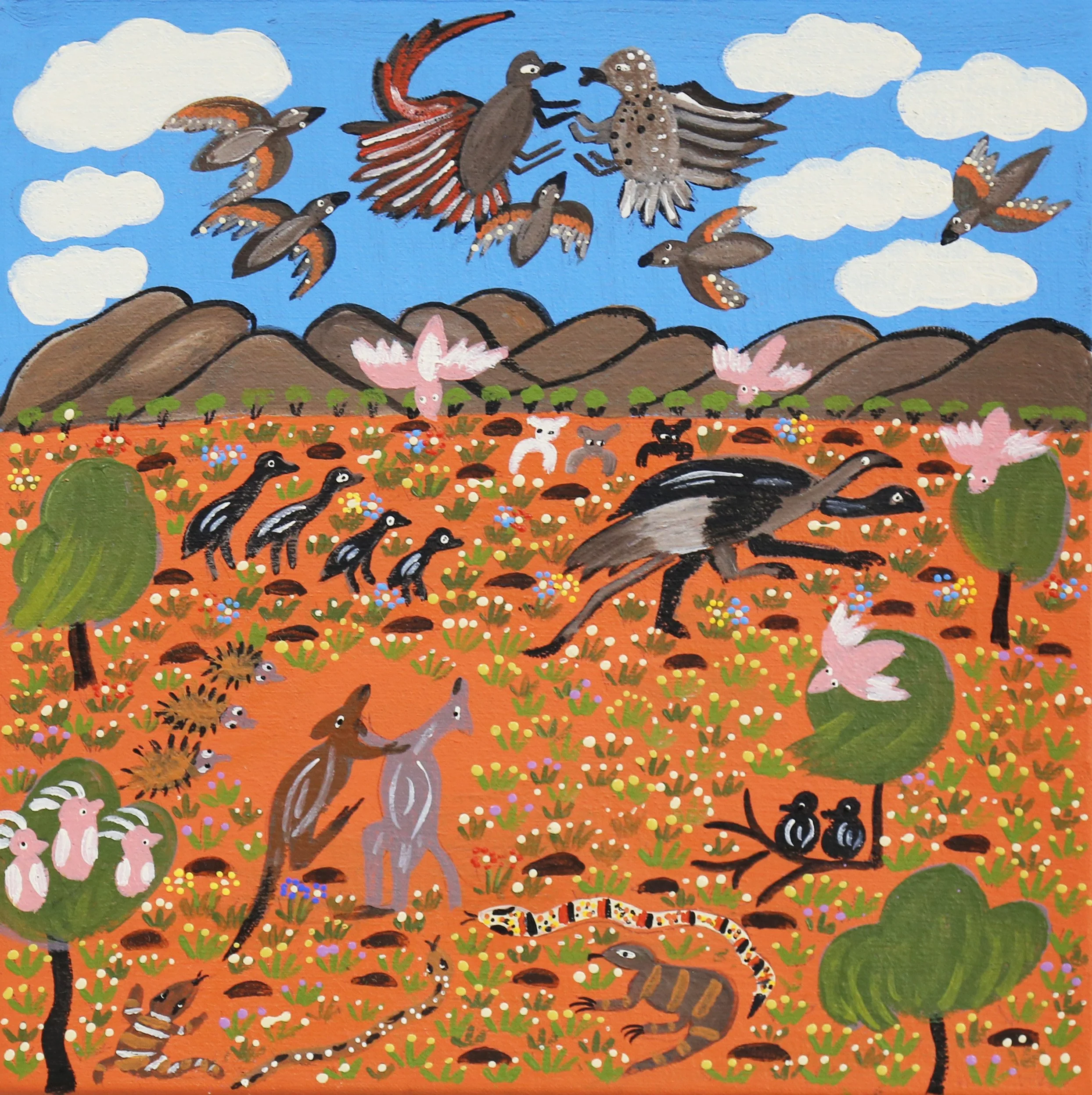
Marjorie Nunga Williams / Animals at Tempe Downs, 2025 #14221-25
30.5 cm x 30.5 cm Acrylic on Linen
‘Tempe Downs. Two emus are running, two kangaroos are fighting, the echidnas are watching the kangaroos fighting, also the lizards and snakes. The cockatoos and two black crow, they all watching these two fighting. Two eagles fighting and these little birds thought it was strange. Snakes are looking at kangaroo fighting. Little baby emus looking at the parents running, their father and mother.’
$330 on stretcher
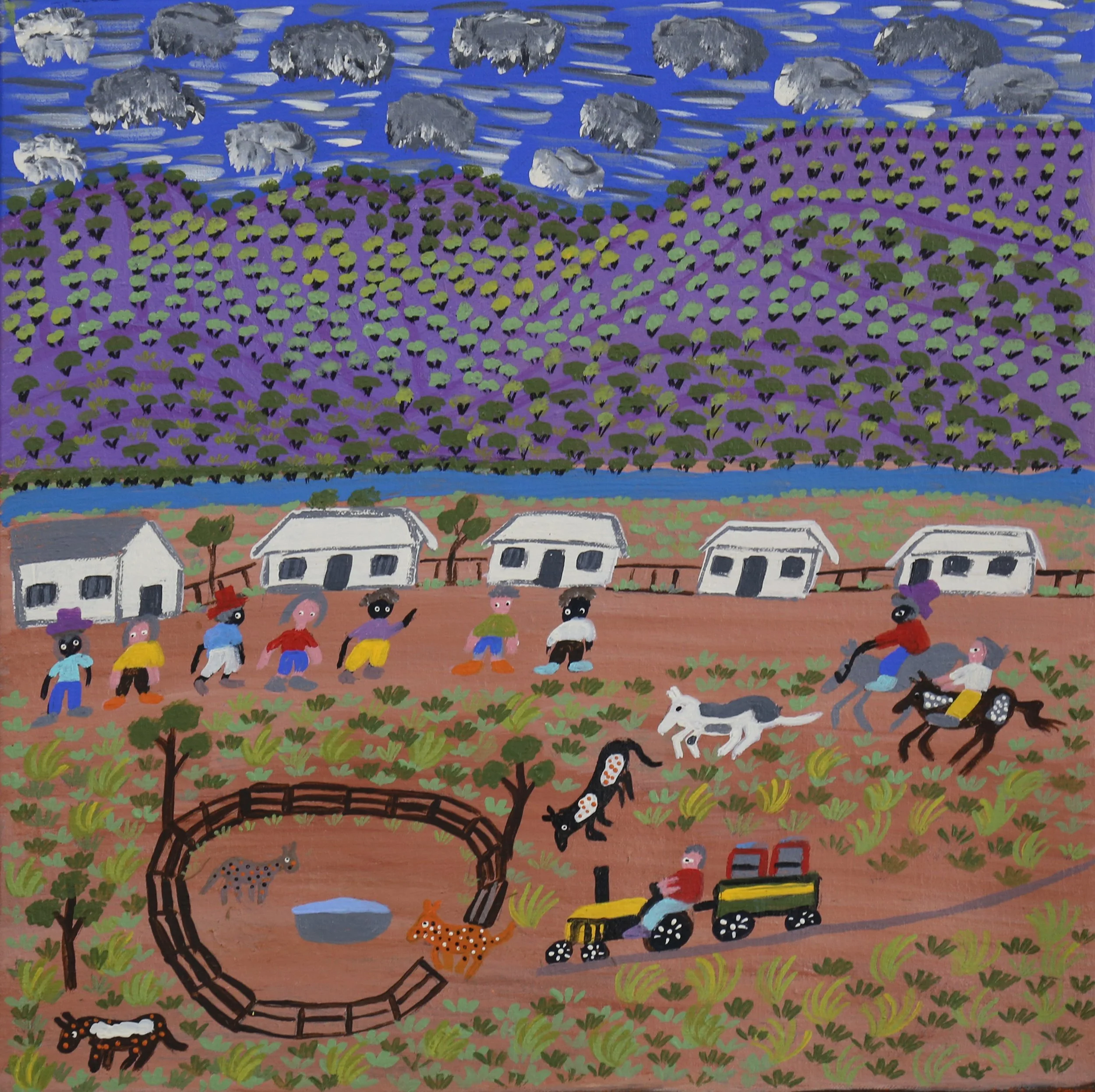
Marjorie Nunga Williams / Ntaria (Hermannsburg), 2025 #14278-25
40.5 cm x 40.5 cm Acrylic on Linen
‘This is a story from old days in Hermannsburg. In the old days they had stock yard and stockmen, they brought the horses in and put them in the yard. Used to be like that before, before I was born. Kele.’
$440 on stretcher
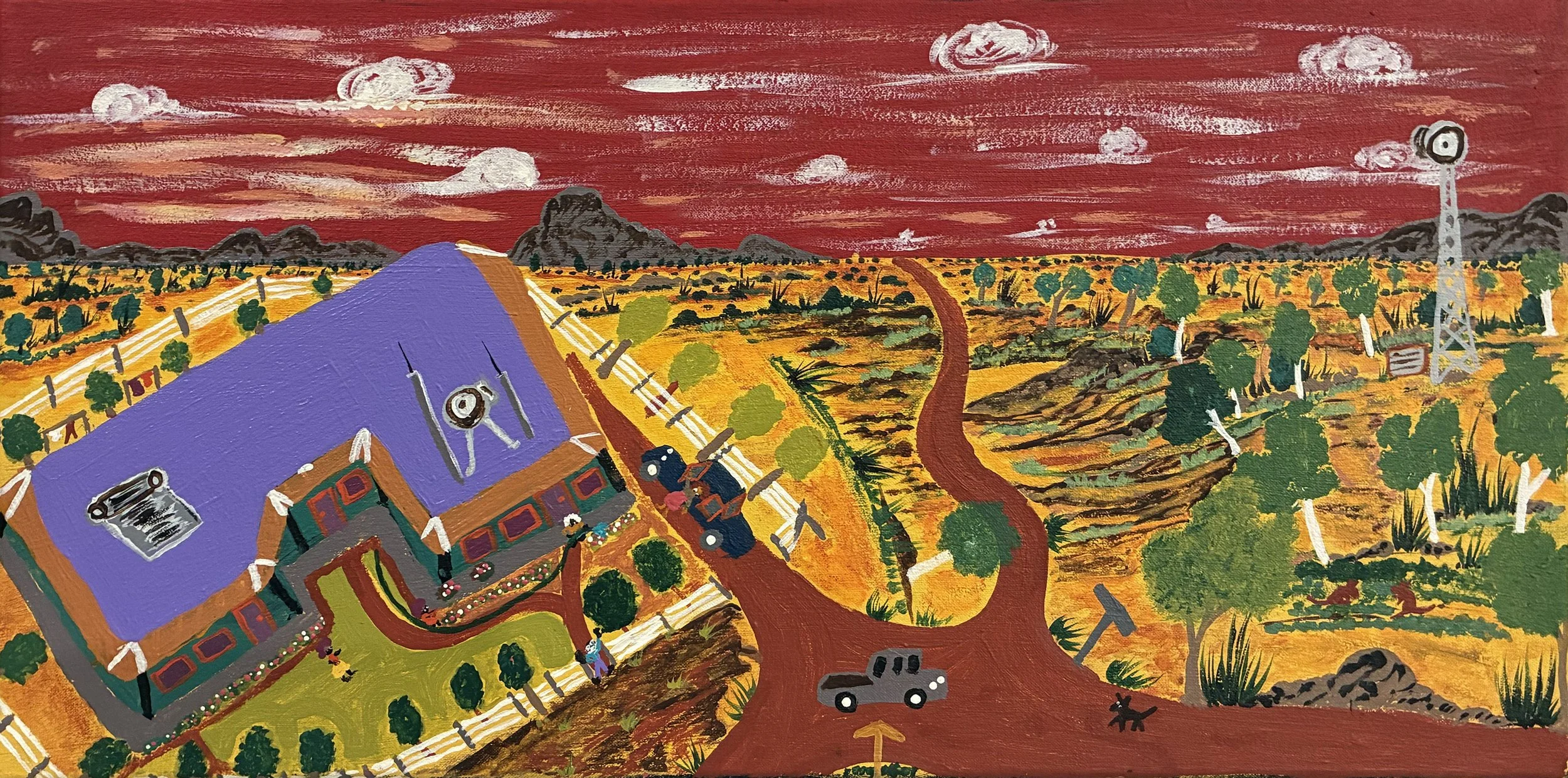
Elizabeth Douglas / Cave Hill Homeland, 2025 #14192-25
30.5 cm x 61 cm Acrylic on Linen
We were sitting outside waiting for the sun to go down, watching one car go past to Amata.
My son was singing out, watching the sunset,
My sister is watering the flowers, two Malu (kangaroo) there and the dog was chasing the malu but then saw the car and started chasing that instead, barking, chasing the car,
Went inside after the sun went down to watch tv.
$300 on stretcher
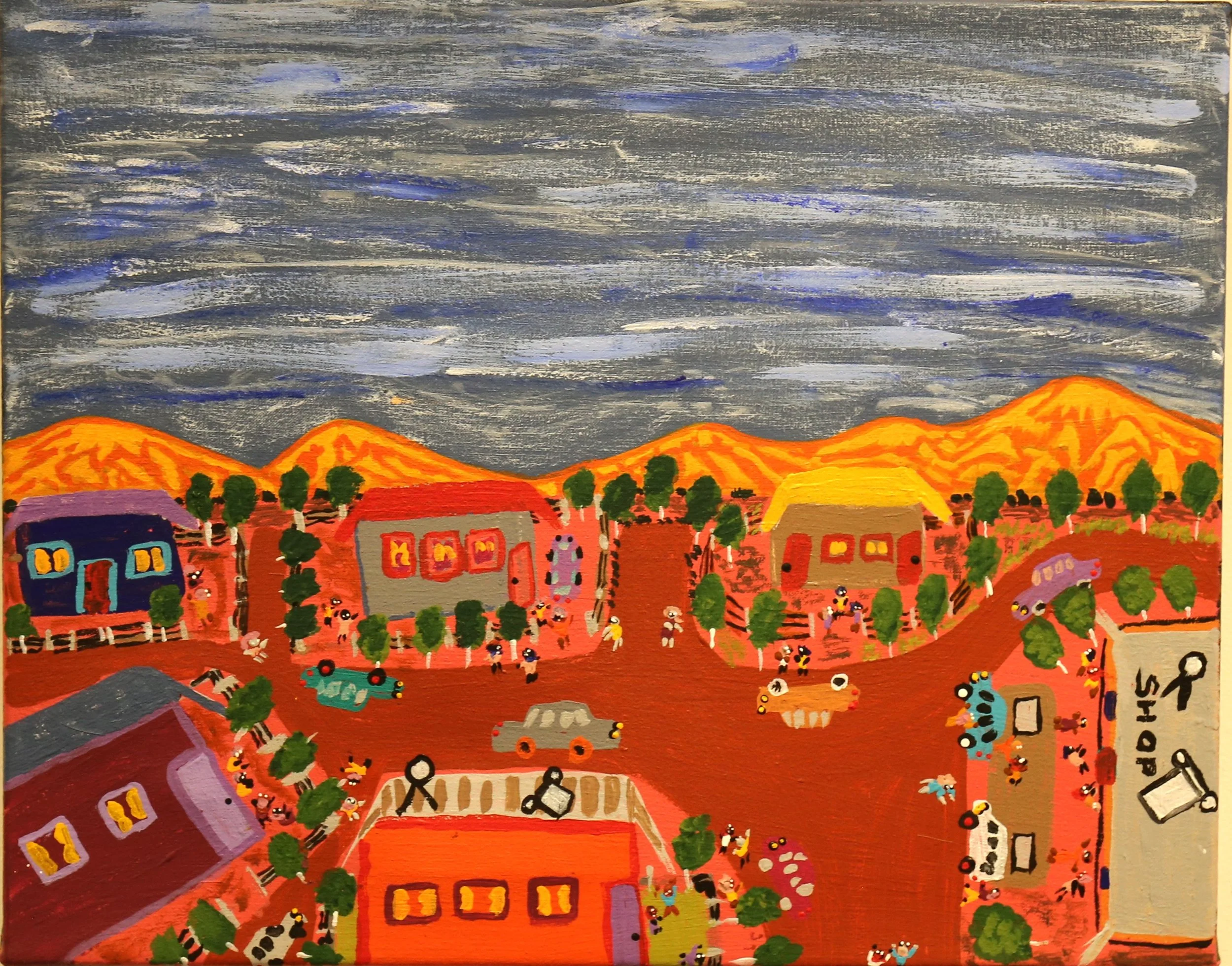
Elizabeth Douglas / Titjikala Shopping Day, 2025 #14309-25
41 cm x 51 cm Acrylic on Linen
‘Shopping day is Titjikala is a very busy day. Families gather at the shop to get food, kids playing in the yard and cars travelling to or from Alice Springs.’
$320
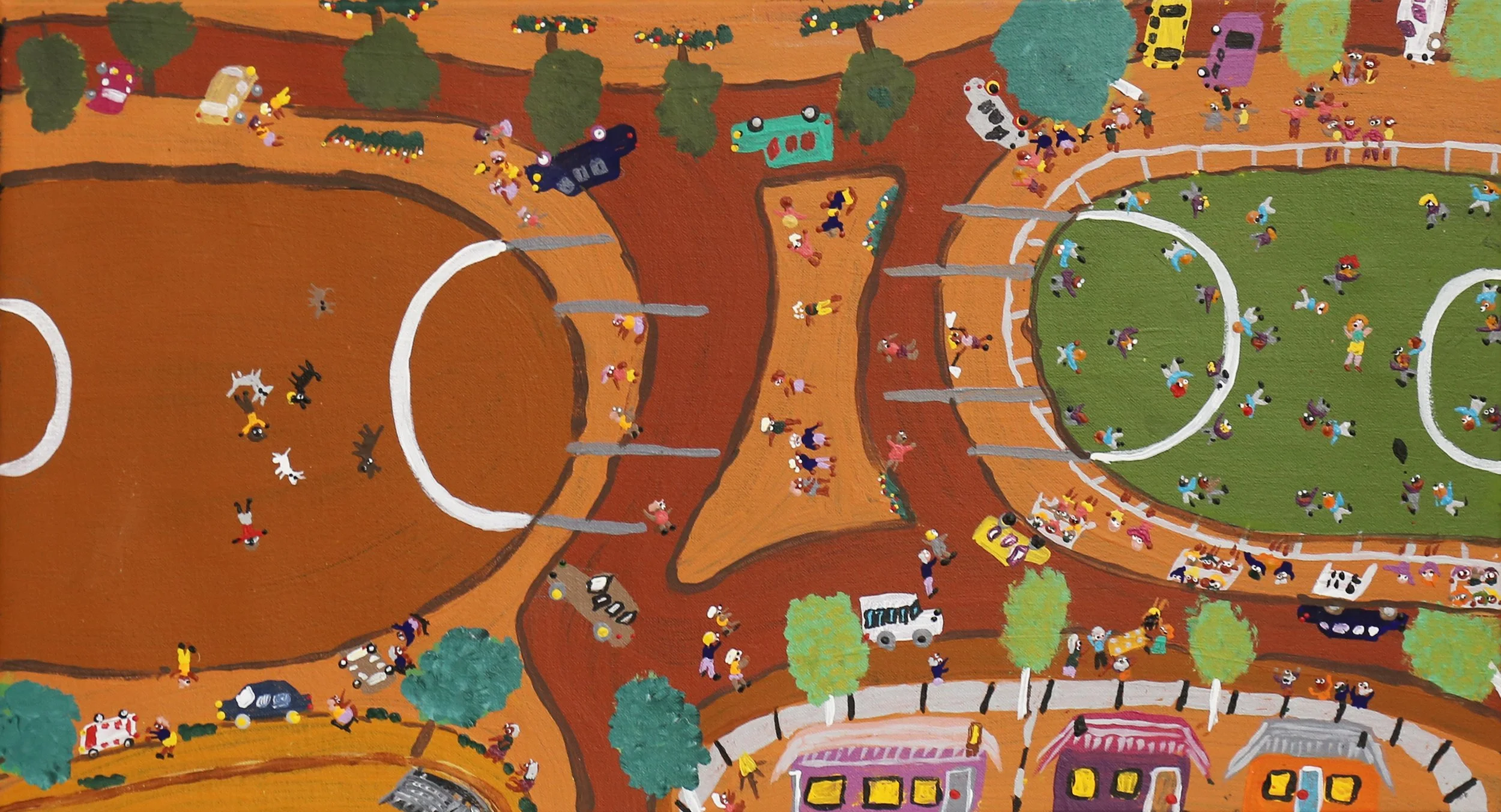
Elizabeth Douglas / Amata Football, 2025 #14291-25
30.5 cm x 56 cm Acrylic on Linen
'They playing football at Amata, everybody watching. That oval over there, kids playing with their dogs.'
$270
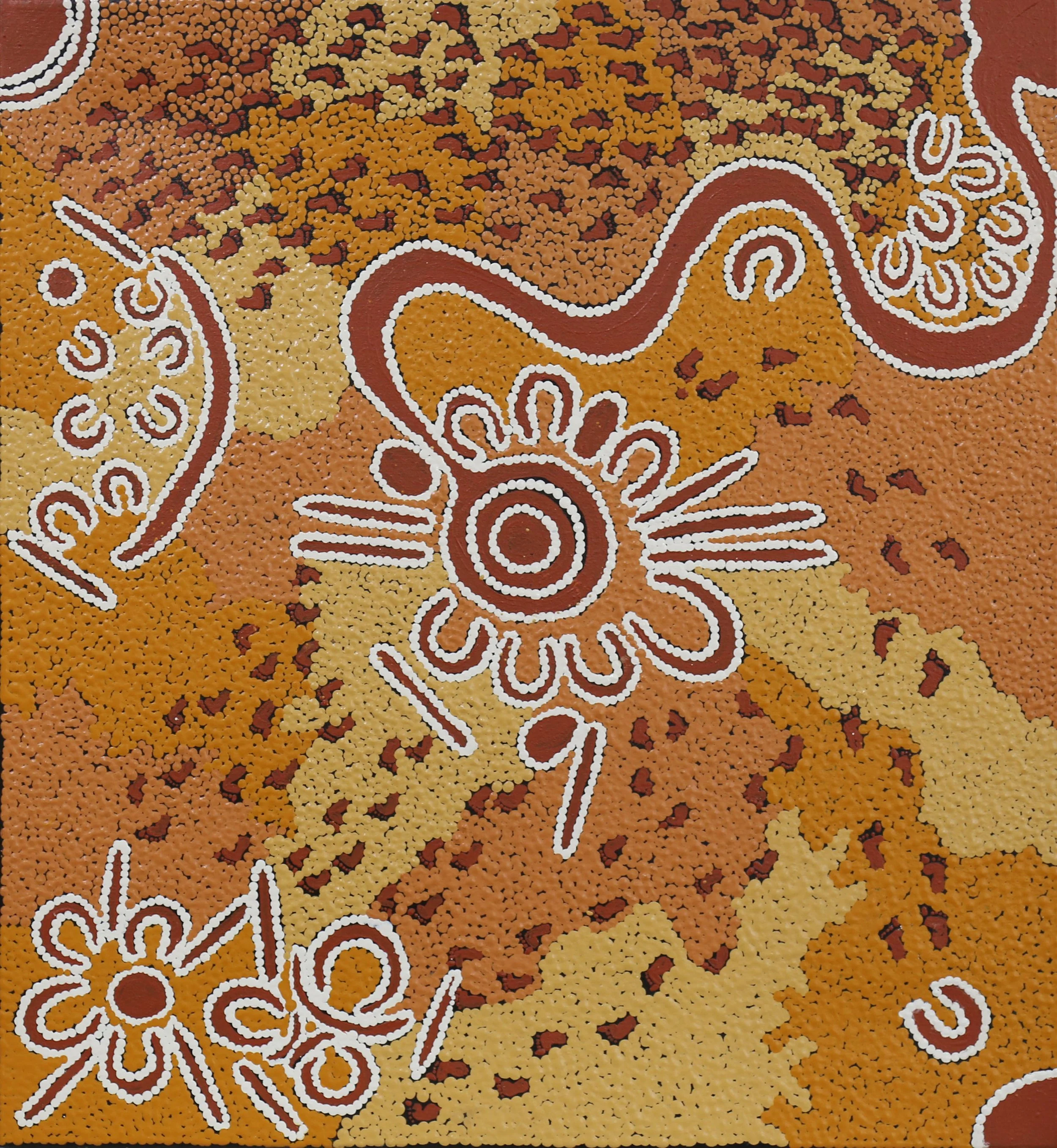
Elizabeth Douglas / Seven Sisters around Cave Hill, 2025 #14200-25
56.5 cm x 61 cm Acrylic on Linen
‘Seven Sisters sitting down next to Cave Hill at the kapi (creek) there. They start to walk, and right in the middle, somewhere round there by the creek. And one man, that cheeky man, Wati Nyiru been watching from behind tree (ghost gum tree – left centre). Been coming on from behind, hunting for the woman, the seven sisters. And young girl was digging. They was sitting there digging for rabbit. And one young one called another sister and told her ‘Stand there and watch out for Wati Nyiru.’ And that sister was standing there, and she saw that man. She was walking round and she saw that man hiding long way, hiding, standing behind that tree. Little sister was standing there watching and sang out ‘there’s the man! Get up! Get up! That man coming. Let’s go! Come on let’s start moving now!’ and other sister (far right foreground), she get up from kapi (creek), and they start running along, all together, headed south. They start moving and get right up. They travel everywhere! Like when you go to Adelaide you see Wati Nyiru lying down by the seaside. They travel here long time, you know. They come from this side – from north to south – the stars, Seven Sisters and Wati Nyiru chasing them. Palya’
$480
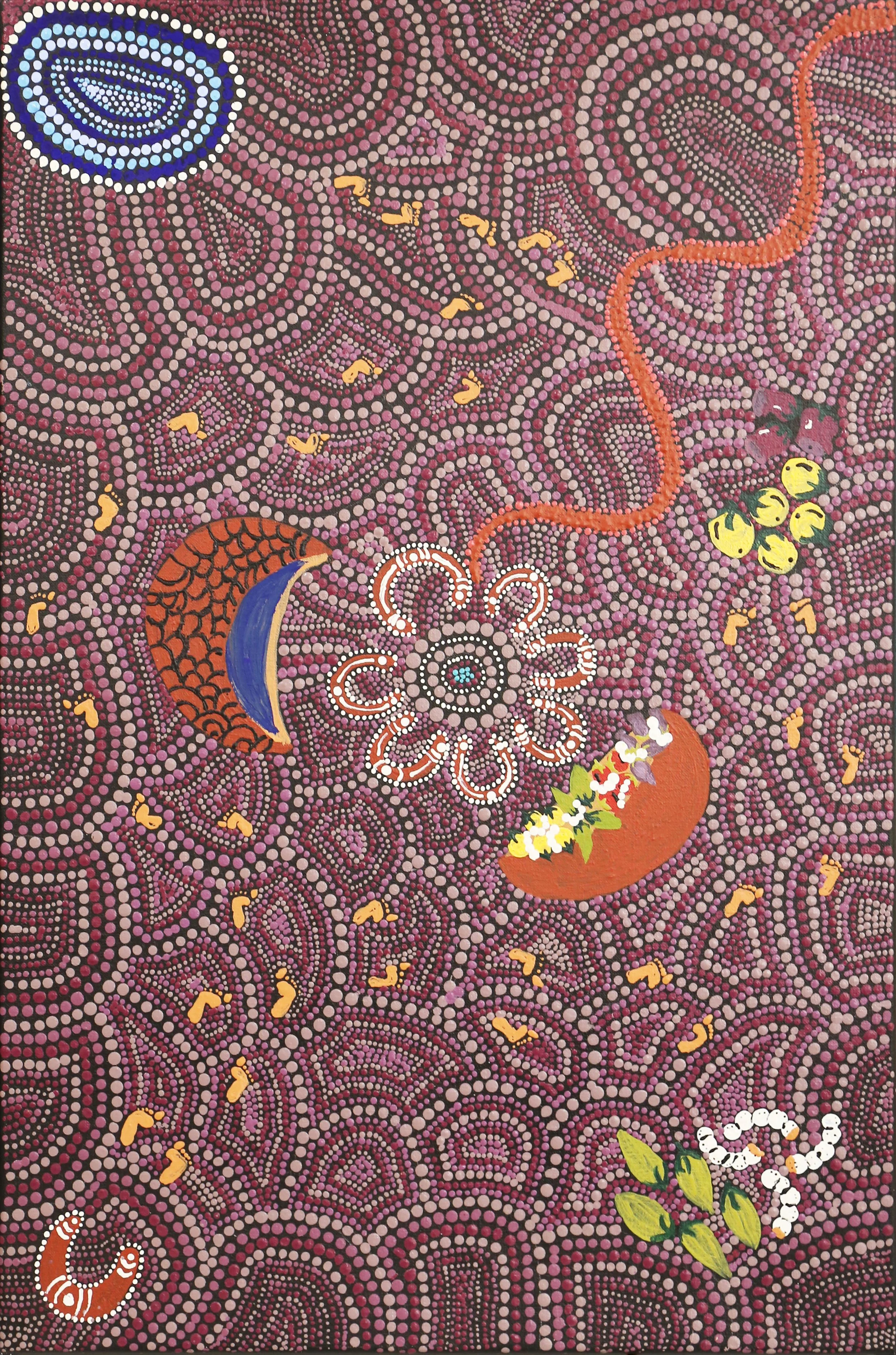
Elizabeth Douglas / Seven Sisters, 2025 #14191-25
41 cm x 61 cm Acrylic on Linen
‘The Seven Sisters is a major Tjukurpa (Dreaming) story told across the Central and Western deserts. It is shared by many Aboriginal communities and speaks of the travels of seven ancestral women being pursued across the land by a man named Wati Nyiru. This painting by Elizabeth is her telling of that ancient story.
In this part of the narrative, the Seven Sisters are running through the bush, trying to escape Wati Nyiru who is following their tracks. As they travel, the sisters gather bush foods and water, carrying them in their coolamons. One sister holds the basket, another carries the water, and they move together through the landscape. Eventually, they return to the cave near Cave Hill — a significant site in the story — seeking shelter from Wati Nyiru’s relentless pursuit. This story is deeply embedded in the land and continues to be passed down through painting, song, dance, and storytelling, connecting people to Country and to ancestral knowledge.
$350
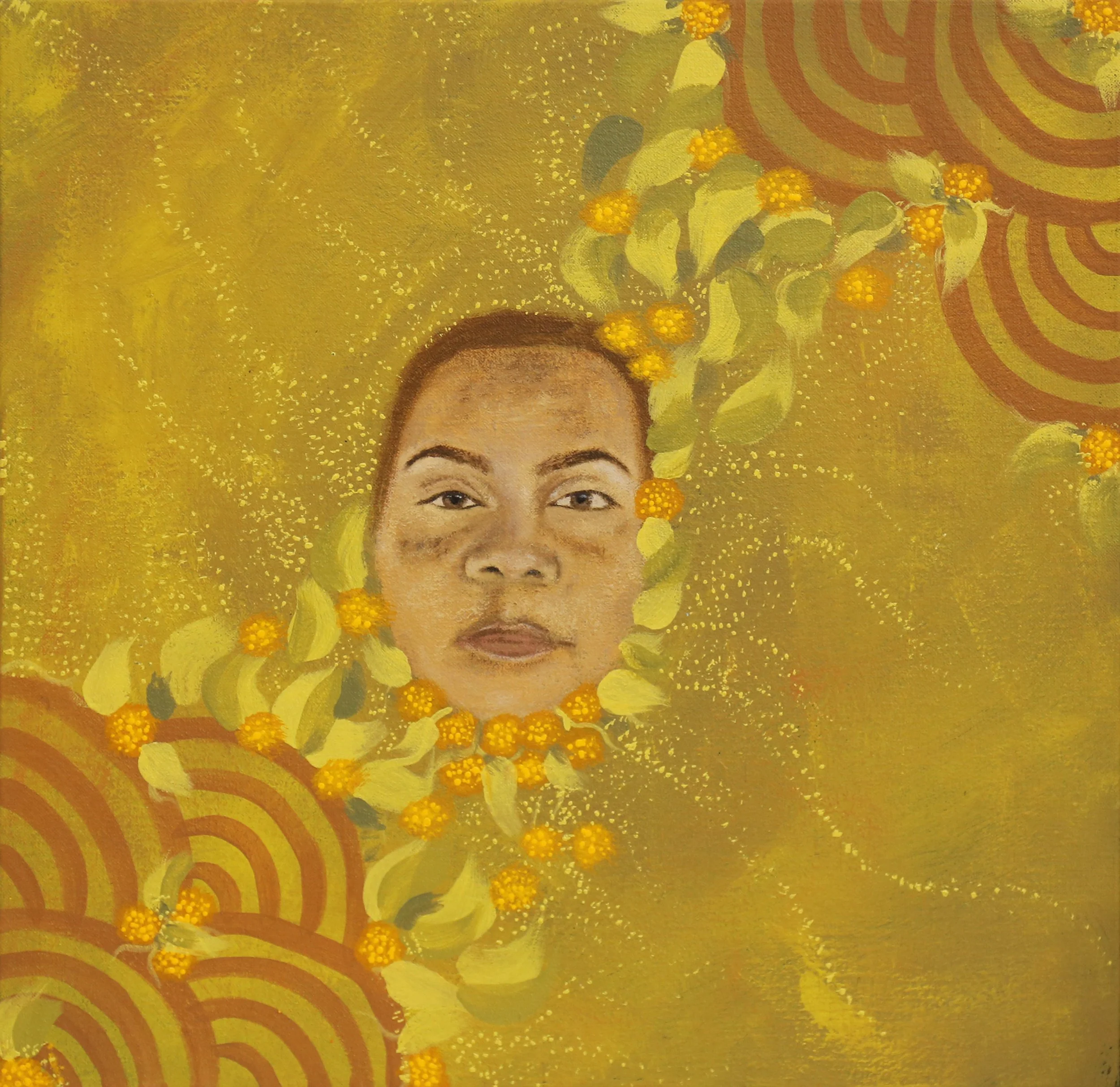
Kyah Armstrong Walker / My Mother, 2025 #14145-25
41 cm x 41 cm Acrylic on Linen
Centered in quiet strength, she emerges in earthy greens and browns, a figure grounded like the soil that sustains life. Around her, yellow blossoms unfold. My Mother.
$330 on stretcher
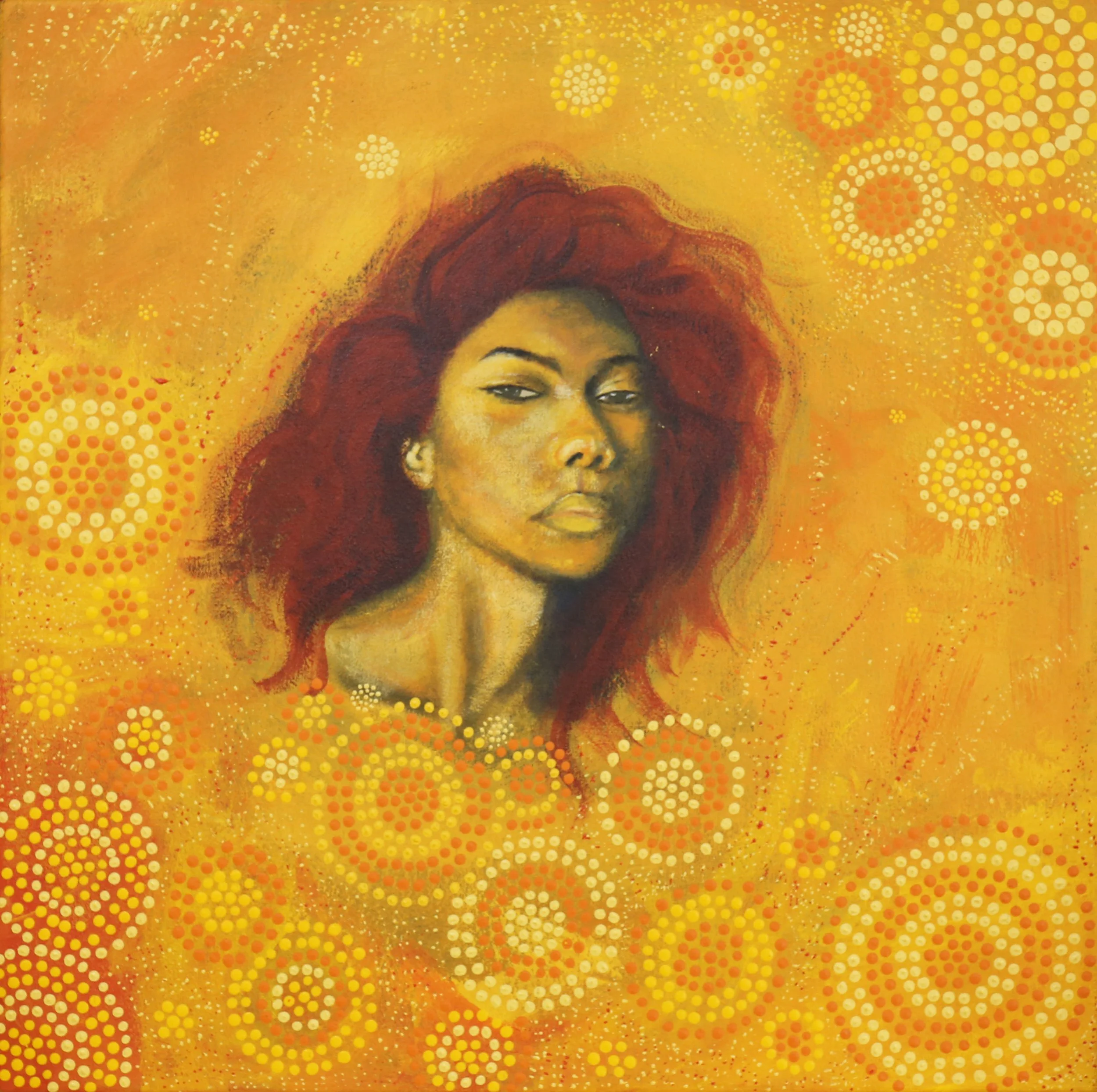
Kyah Armstrong Walker / NT Beauty, 2025 #14179-25
56 cm x 56 cm Acrylic on Linen
‘Cindy Rostron, she’s our NT Beauty. She shows beauty can come in many forms.’
$440

Kyah Armstrong Walker / A Glimpse into the Past, 2025 #14131-24
58.5 x 89.5 cm Acrylic on Linen
‘Days of our ancestors. I imagined this is what it would be like. Men coming back after hunting, woman nursing babies and the tribe all sitting around the fire as the sun sets and the days ended.’
$750
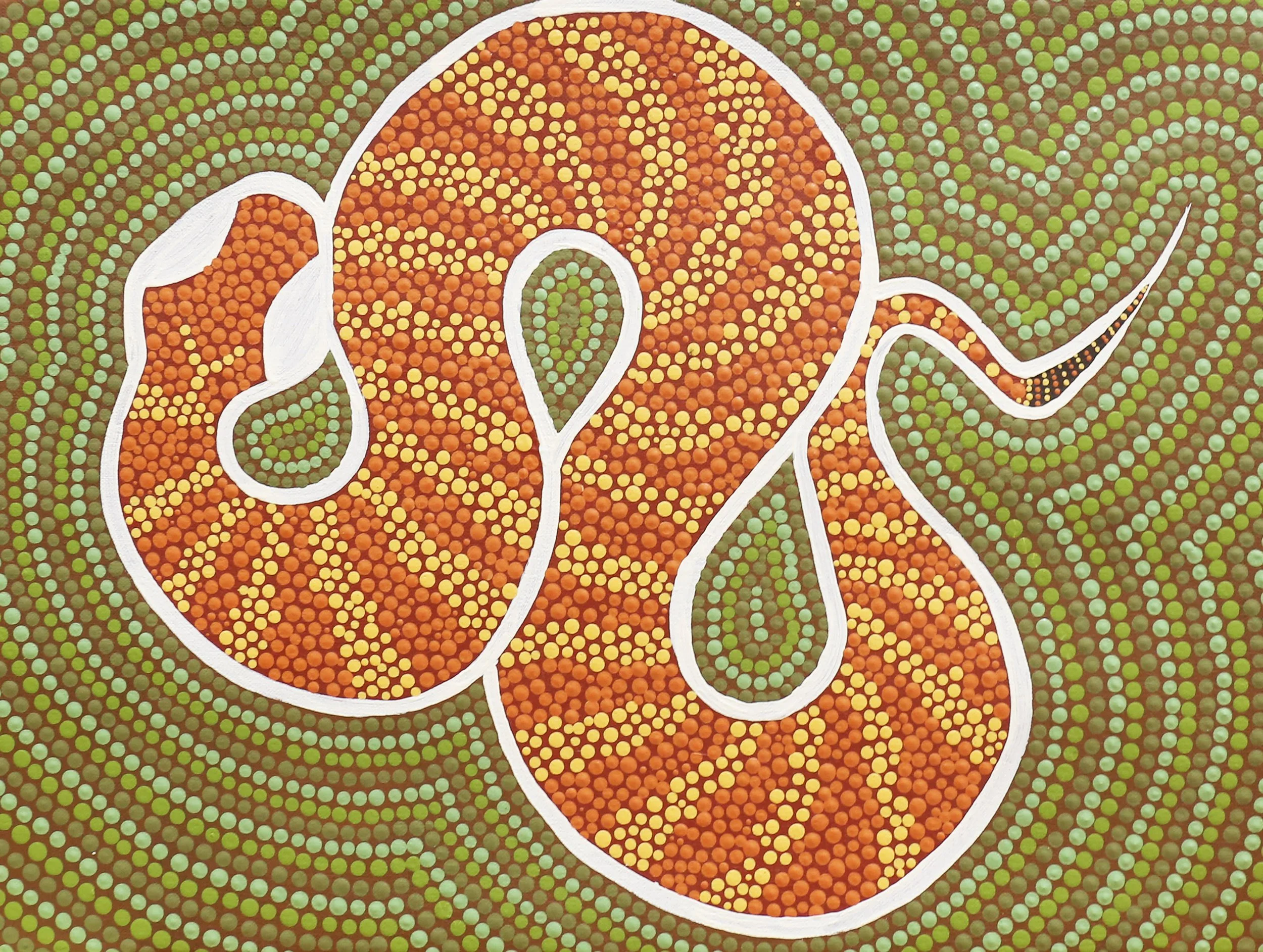
Danae Moore / Mantharre (Death Adder), 2025 #14106-25
30.5 cm x 41 cm Acrylic on Linen
Mantharre is the name of the death adder in Kaytetye. Kaytetye is the language Danae speaks and is from around the Barrow Creek area.
$280 on stretcher
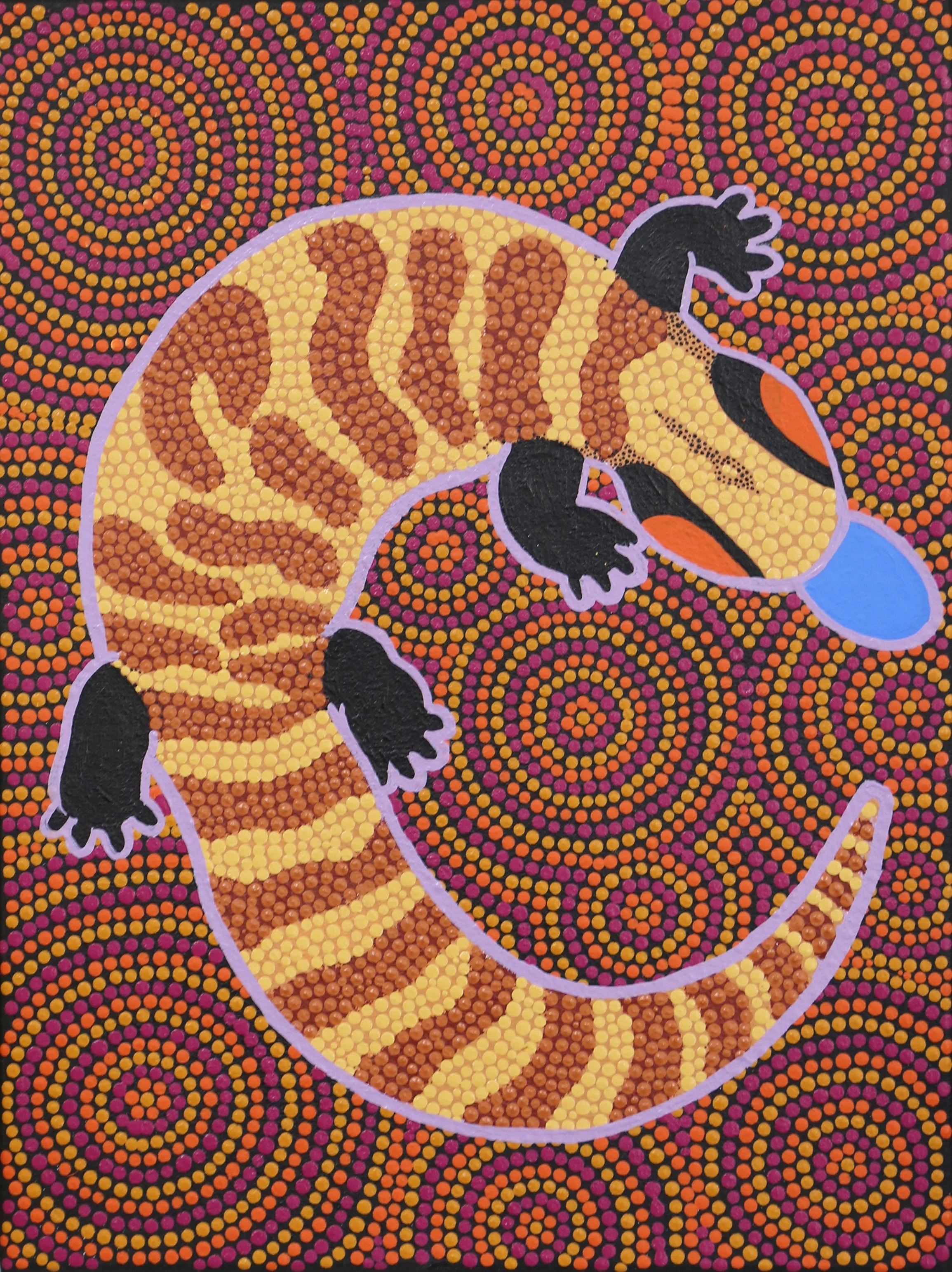
Danae Moore / Lungkata (Blue Tongue Lizard), 2025 #14128-25
30.5 cm x 41 cm Acrylic on Linen
This painting is about the Lungkata (Blue Tongue Lizard). He walks all over the countryside.
$280 on stretcher
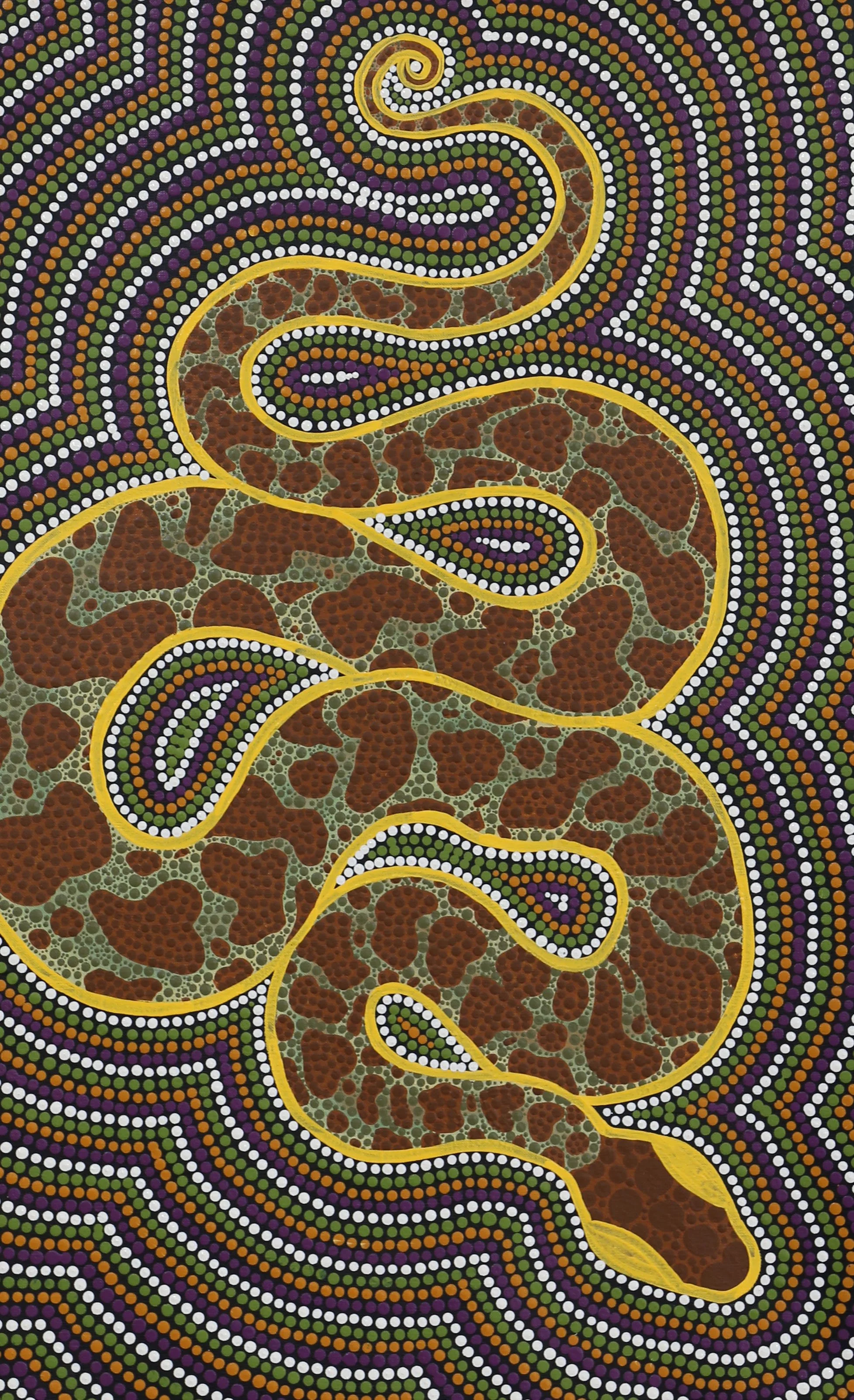
Danae Moore / Rainbow Serpent protecting Waterholes, 2025 #14033-25
41 cm x 66 cm Acrylic on Linen
This painting represents a Rainbow Serpent protecting a series of waterholes. The circles represent waterholes. Most bodies of water throughout Central Australia are sacred sites, even if they are only temporary. In most instances they are protected by resident Rainbow Serpents from strangers. The narrative around the activity of each Rainbow Serpent may differ, however, the principle that they protect waterholes from strangers remains constant. When approaching bodies of water, those with associations to the waterhole will announce their arrival by singing or calling out, or even tossing a stone in the water, telling the Serpent of their arrival, naming themselves and their kin relationship to the Serpent, and imploring the Serpent for its protection from any trouble. Strangers accompanying those people are also introduced and protection sought for the strangers as well.
$450
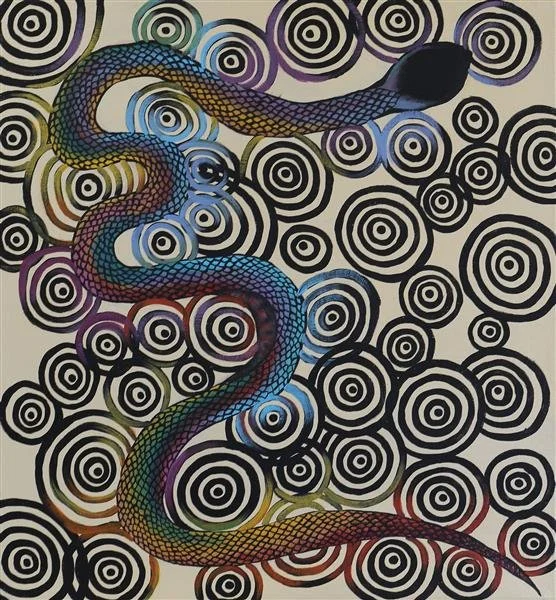
Danae Moore / Rainbow Serpent protecting Waterholes, 2025 #13933-25
56.5 cm x 61 cm Acrylic on Linen
This painting represents a Rainbow Serpent protecting a series of waterholes. The wavy coloured lined represent the Ancestral Serpent, and the circles represent waterholes. Most bodies of water throughout Central Australia are sacred sites, even if they are only temporary. In most instances they are protected by resident Rainbow Serpents from strangers. The narrative around the activity of each Rainbow Serpent may differ, however, the principle that they protect waterholes from strangers remains constant. When approaching bodies of water, those with associations to the waterhole will announce their arrival by singing or calling out, or even tossing a stone in the water, telling the Serpent of their arrival, naming themselves and their kin relationship to the Serpent, and imploring the Serpent for its protection from any trouble. Strangers accompanying those people are also introduced and protection sought for the strangers as well.
$550
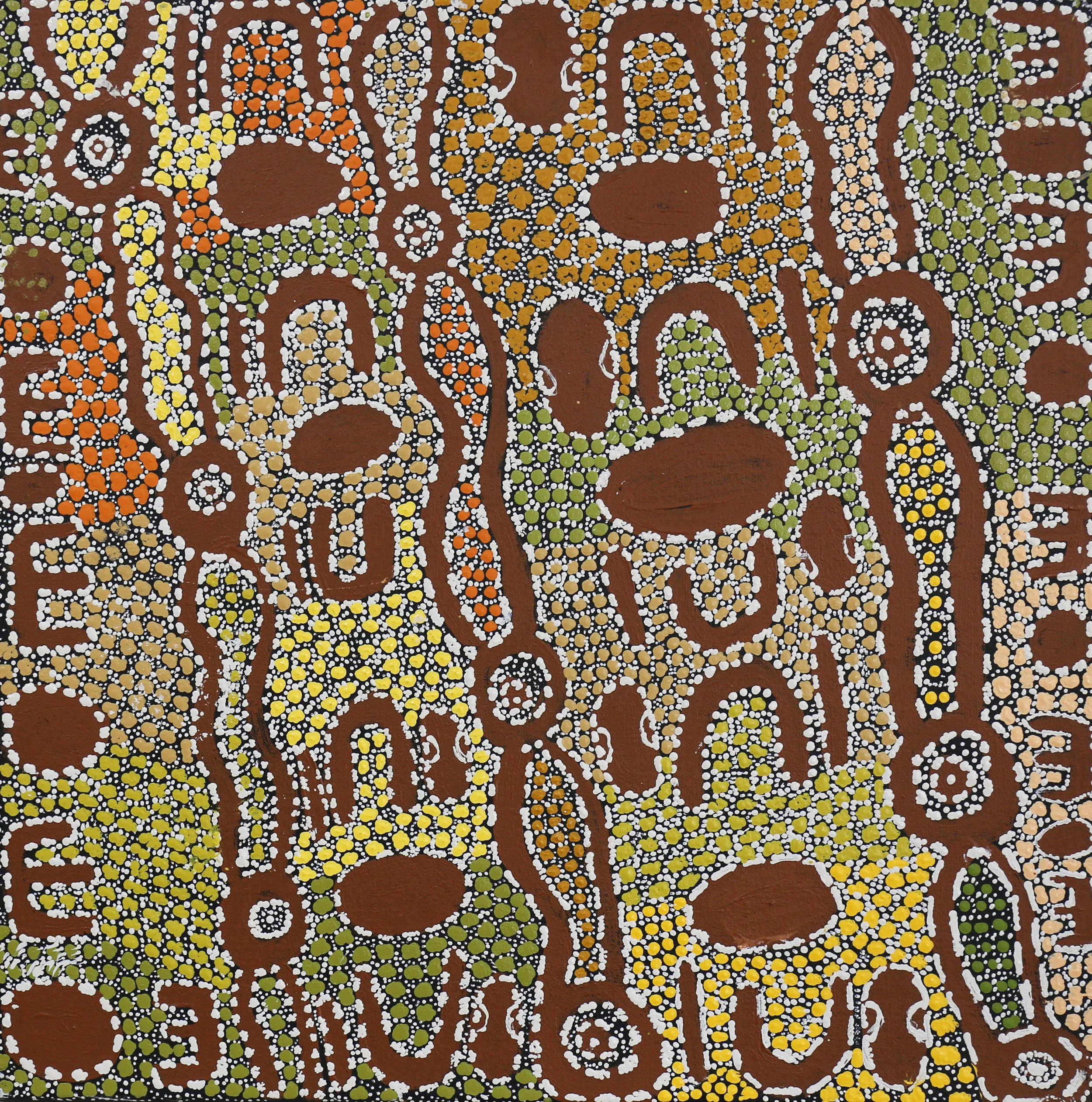
Mabel Watson Wilson / Emu Dreaming, 2025 #14163-25
56 cm x 56 cm Acrylic on Linen
Emu looking around for water. This is a Dreaming story from my father's country, other side of Yuendumu. Past Mandarin Station, through there and other side. Emu looking round for water, they are three waterholes. I've painted the country side after big rain, flowers everywhere. The emu is looking for yellow fruit to eat, with seed. The snake is in the waterholes.
$430
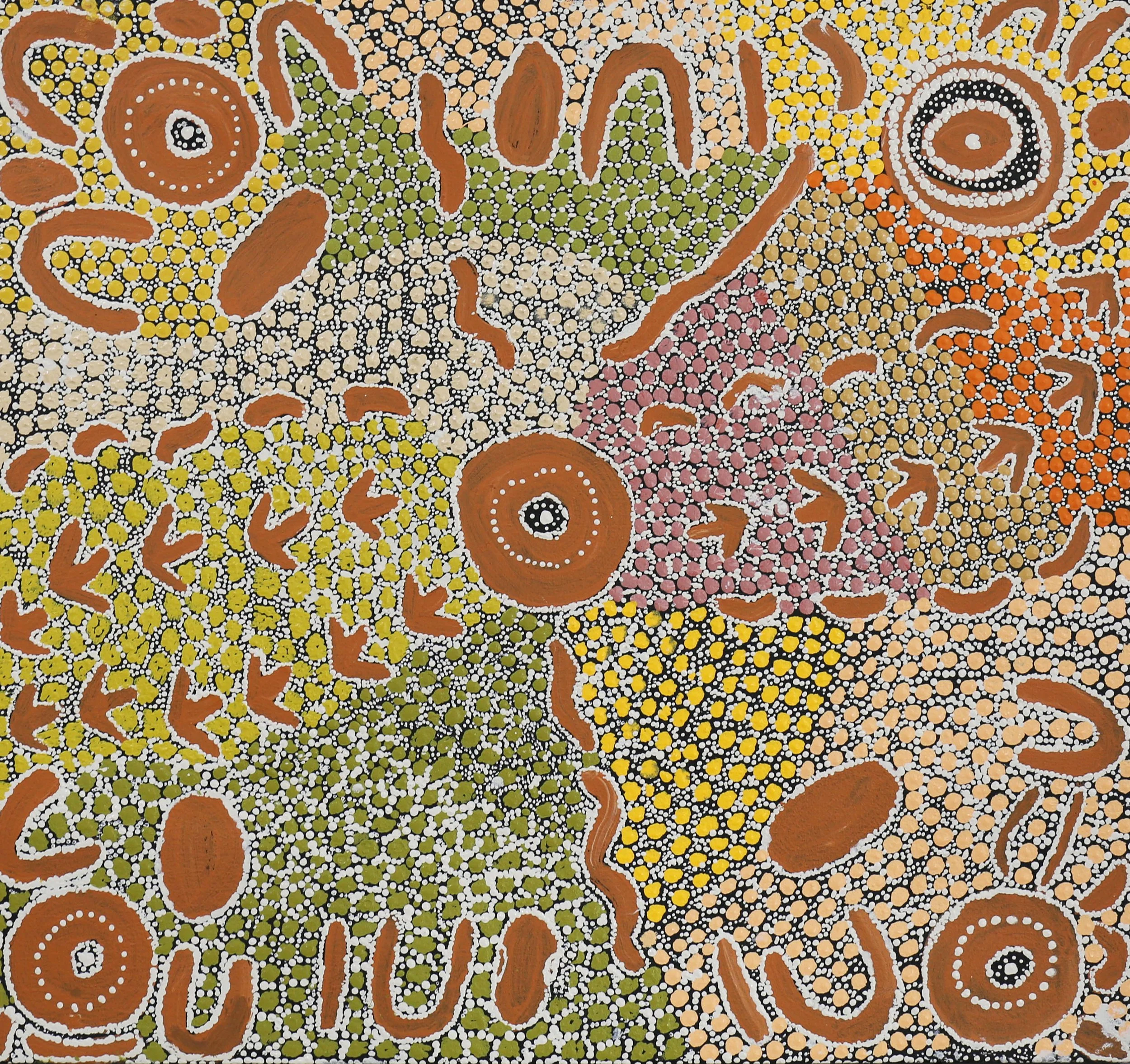
Mabel Watson Wilson / Emu Dreaming, 2025 #14163-25
55.5 cm x 59.5 cm Acrylic on Linen
Emu looking around for water. This is a Dreaming story from my father's country, other side of Yuendumu. Past Mandarin Station, through there and other side. Emu looking round for water, they are three waterholes. I've painted the country side after big rain, flowers everywhere. The emu is looking for yellow fruit to eat, with seed. The snake is in the waterholes.
$400
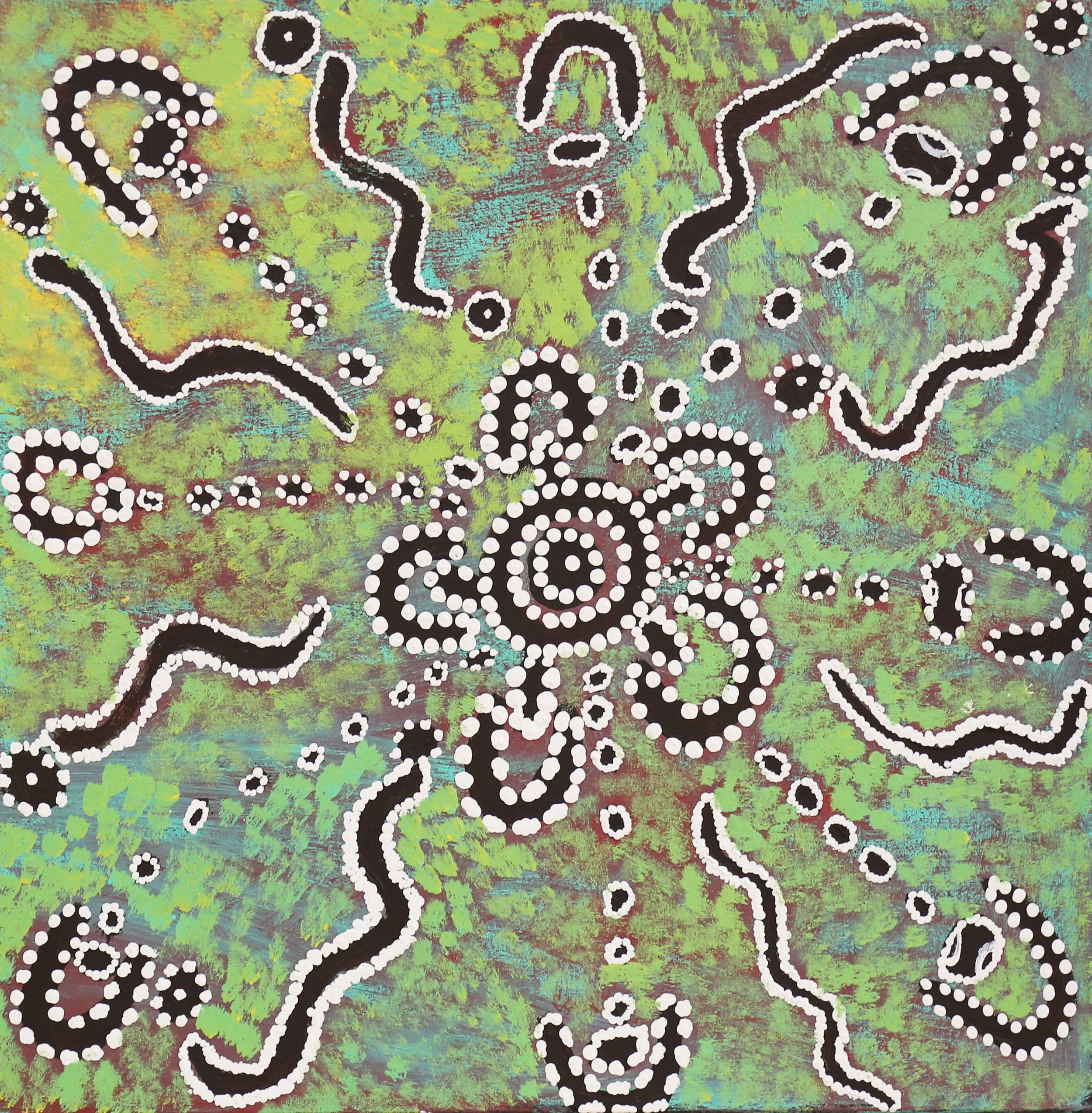
Mabel Watson Wilson / Looking around for waterholes, 2025 #14256-25
56 cm x 56 cm Acrylic on Linen
This painting tells the story of the artist’s family — her grandmother and aunty — walking across Country in search of waterholes and bush tucker. It captures an important part of life in the old days, when people travelled with deep knowledge of the land, following the signs of water and seasonal foods.
In the painting, the ‘U’ shapes represent the people sitting on the ground. Beside them are digging sticks and coolamons, traditional tools used by women for digging and carrying bush tucker and water. The wavy lines trace the paths of creeks and watercourses, while the circles mark the waterholes found along the way.
$440
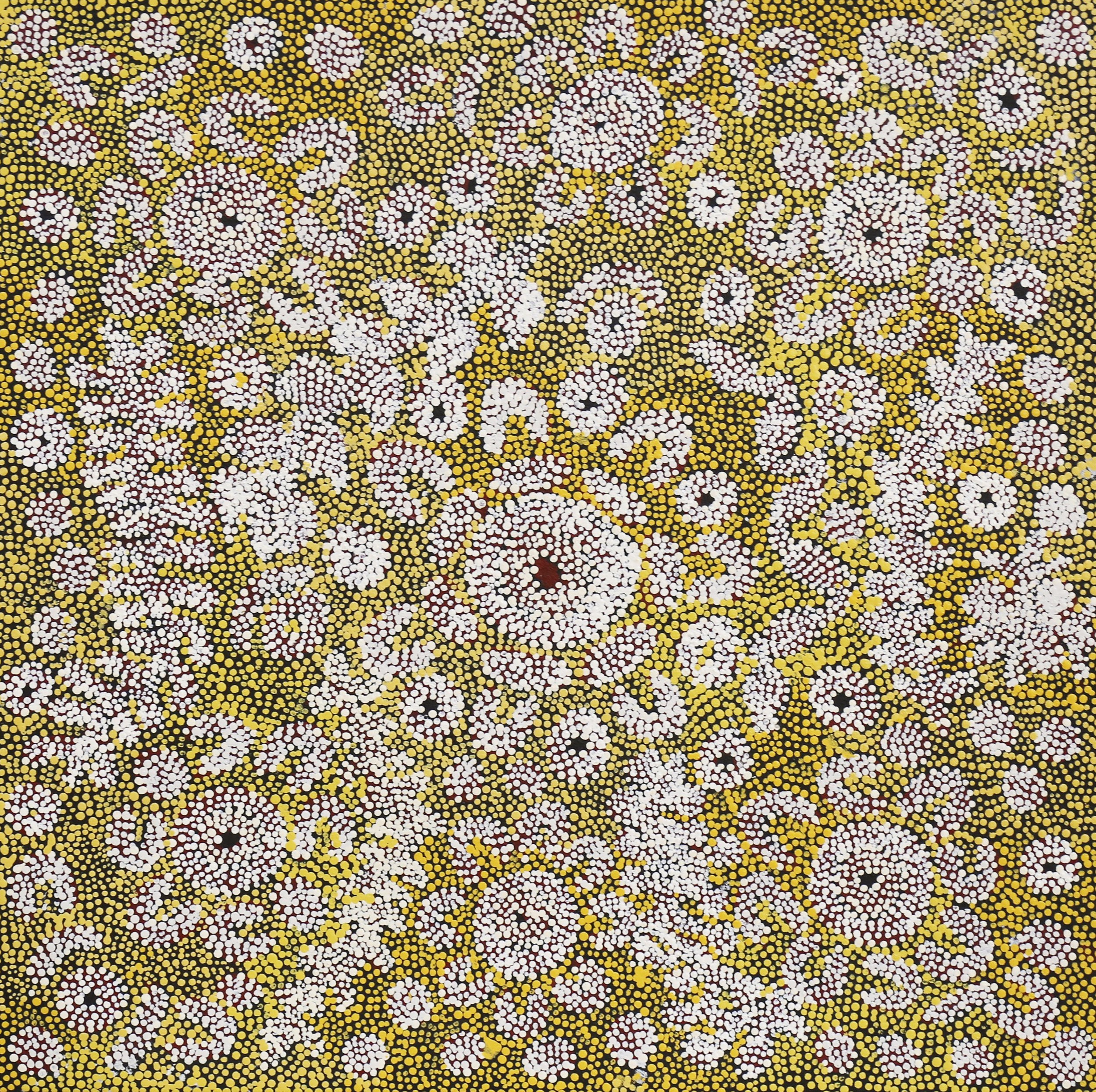
Rhonda Napanangka / Kapi Dreaming, Karrinyarra, 2025 #14061-25
56.5 cm x 56 cm Acrylic on Linen
'My grandfather’s country, my uncle’s country and my mother’s country. A waterhole ‘Waturlpunya’ in Karrinyarra and a chain of pointy hills, all within one country. I’ve been seeing those hills, part of that country. I only paint this one story. I depict all the woman sitting down, story telling. They’re here with their nulla nullas. This one is another waterhole, there’s lots of food here - bush tomato and other fruit. The women were looking for food that’s in abundance and have collected bush bean. They’ve lived off bush tucker for a long time. They’re sitting at the water’s edge resting after foraging for bush tucker. They’re watching the waterhole and digging for water, collecting it, stooped, with their heads down, seated on the ground. They’ve been living there in a big camp for a long time, in this distant place. A long time ago they camped in another place in Waturlpunyu … a long time before now, around another big waterhole in a water dreaming place. They camped there for some time before they grew up and spread out in many different directions moving to communities like Papunya. Papunya was close by, so they ended up staying there. That’s my uncle and that’s my mother. This is my father’s Tjukurrpa, and Grandfather’s hills in Karrinyarra.'
$500
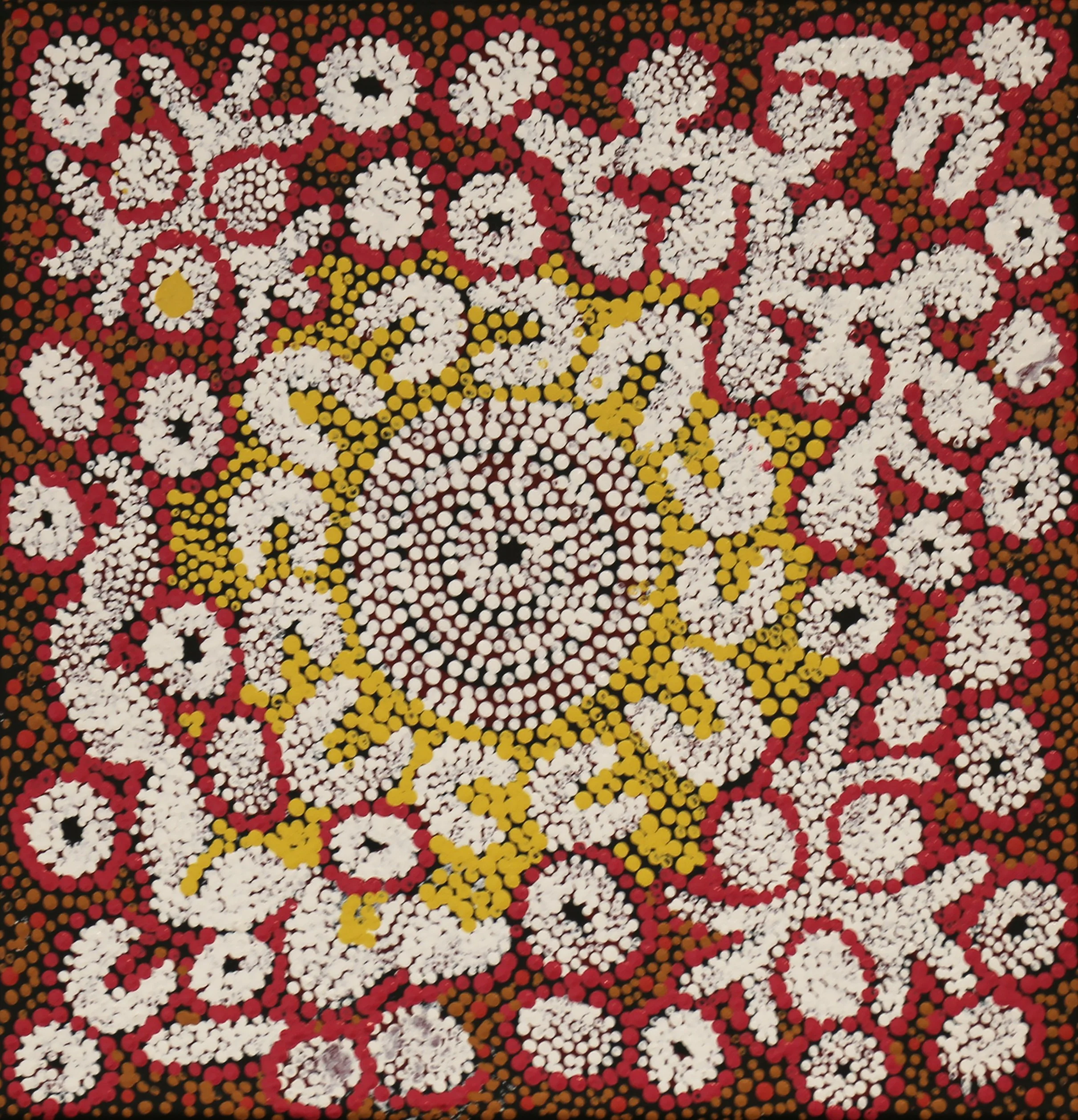
Rhonda Napanangka / Kapi Dreaming, Karrinyarra, 2025 #14283-25
30.5 cm x 30.5 cm Acrylic on Linen
'My grandfather’s country, my uncle’s country and my mother’s country. A waterhole ‘Waturlpunya’ in Karrinyarra and a chain of pointy hills, all within one country. I’ve been seeing those hills, part of that country. I only paint this one story. I depict all the woman sitting down, story telling. They’re here with their nulla nullas. This one is another waterhole, there’s lots of food here - bush tomato and other fruit. The women were looking for food that’s in abundance and have collected bush bean. They’ve lived off bush tucker for a long time. They’re sitting at the water’s edge resting after foraging for bush tucker. They’re watching the waterhole and digging for water, collecting it, stooped, with their heads down, seated on the ground. They’ve been living there in a big camp for a long time, in this distant place. A long time ago they camped in another place in Waturlpunyu … a long time before now, around another big waterhole in a water dreaming place. They camped there for some time before they grew up and spread out in many different directions moving to communities like Papunya. Papunya was close by, so they ended up staying there. That’s my uncle and that’s my mother. This is my father’s Tjukurrpa, and Grandfather’s hills in Karrinyarra.'
$230 on stretcher
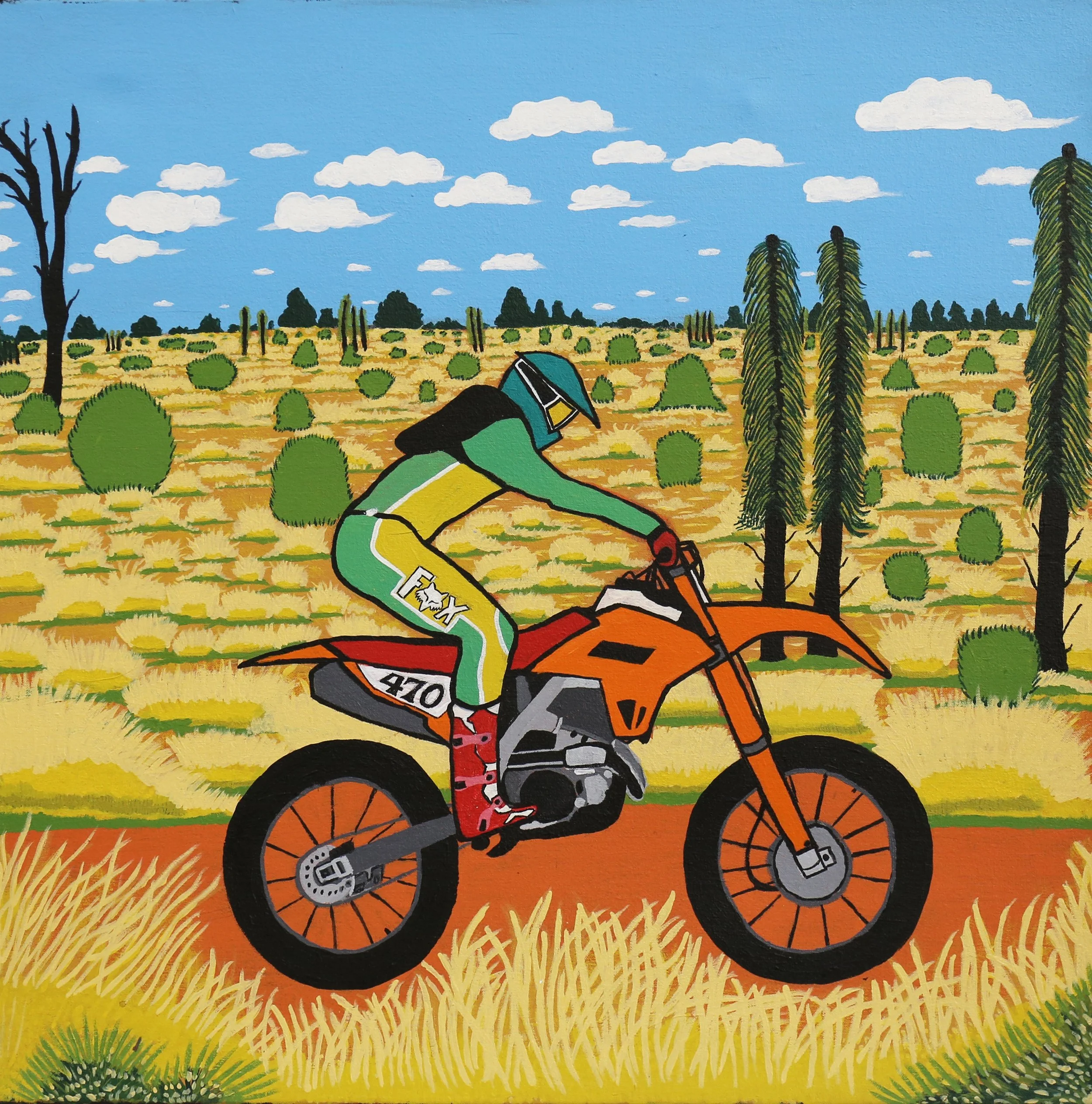
Nathan Doolan / Finke Desert Race, 2025 #14290-25
56 cm x 56 cm Acrylic on Linen
'Finke deser race motorcycle rider'
$400
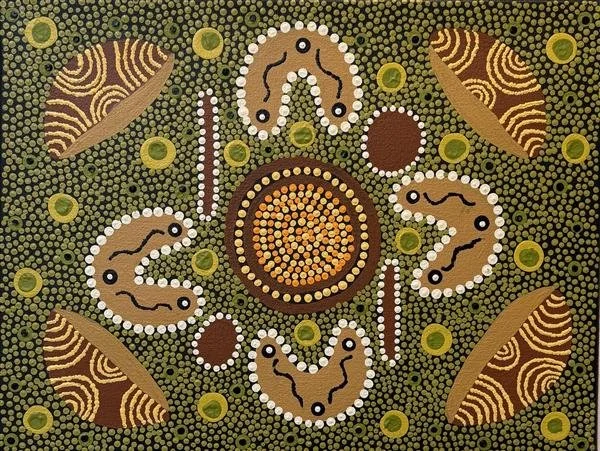
Gwen Gillen / Women Digging for Honey Ants, 2025 #14288-25
31 cm x 41 cm Acrylic on Linen
Women planning their dig for Honey Ants. Honey Ants hang from the ceiling of chambers their family dig out of the earth. The tunnels into the chambers are long and complex. That means the Honey Ants have to be tracked, and then the women use informed guesswork based on experience to decide where to dig. The process can take hours of very hard work, but the ladies are always completely rewarded when they find those delicious ants whose abdomens are full of sweet honey.
$220 on stretcher
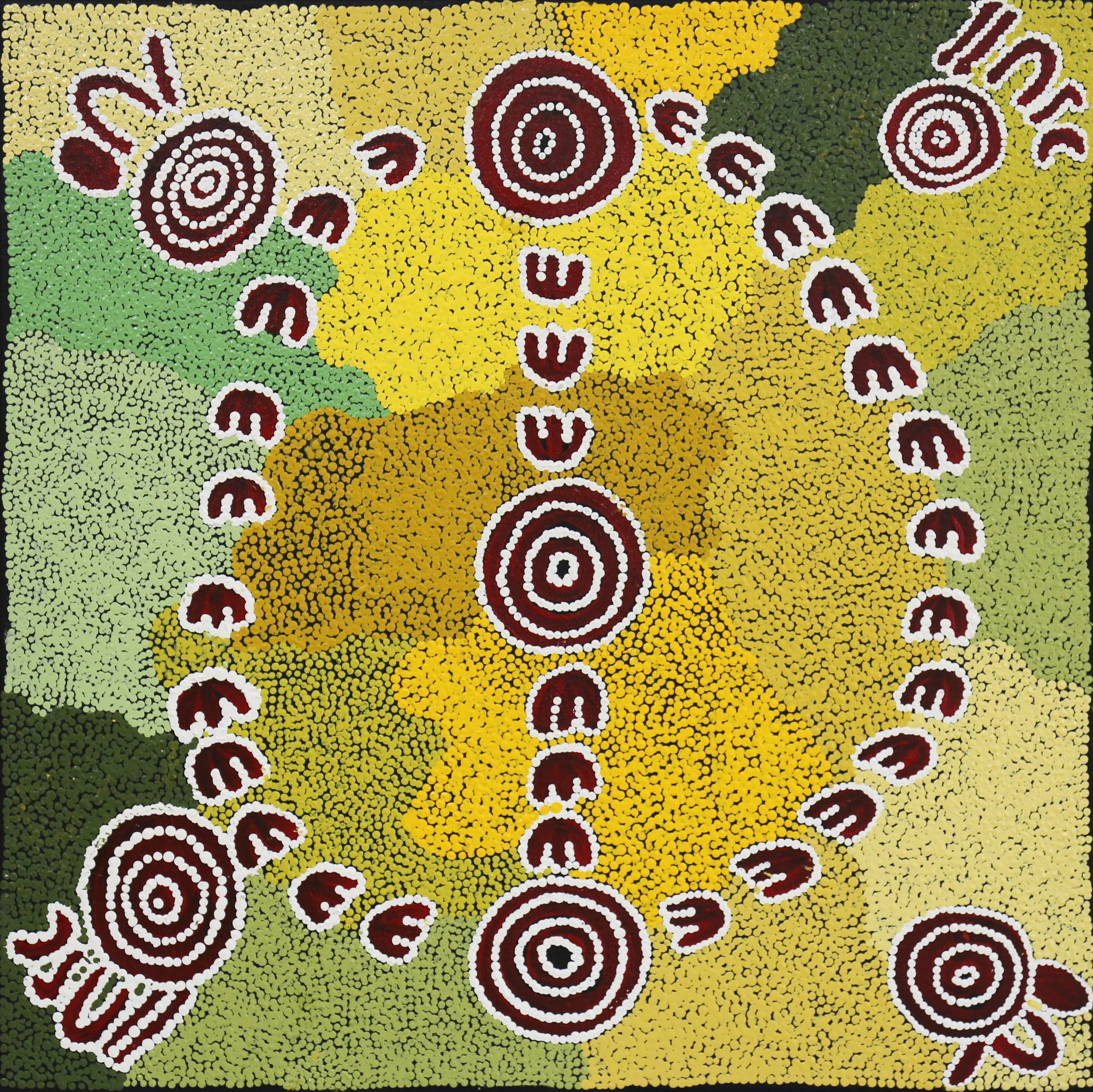
Maryanne Raggett Nungarrayi / Ceremony at M'Bunghara, 2025 #13876-25
56 cm x 56 cm Acrylic on Linen
Ceremony on M’Bunghara Creek. The country of M’Bunghara is depicted as a combination of creek and open desert. Maryanne’s ‘landscape’ is scattered with humpies, with people [indicated by U shapes] sitting down around fires [circles surrounded by U shapes], performing Ceremony. This Ceremony is open to all – men, women and children participating.
M’Bunghara, located on M’Bunghara Creek [known as Dashwood Creek] surrounded by Glen Helen Station, is where Maryanne was born to her mother Daisy Leura Nakamarra and father Tim Leura Tjapaltjarri. It is now home to a small Outstation Community of extended family, also called M’Bunghara.
$600
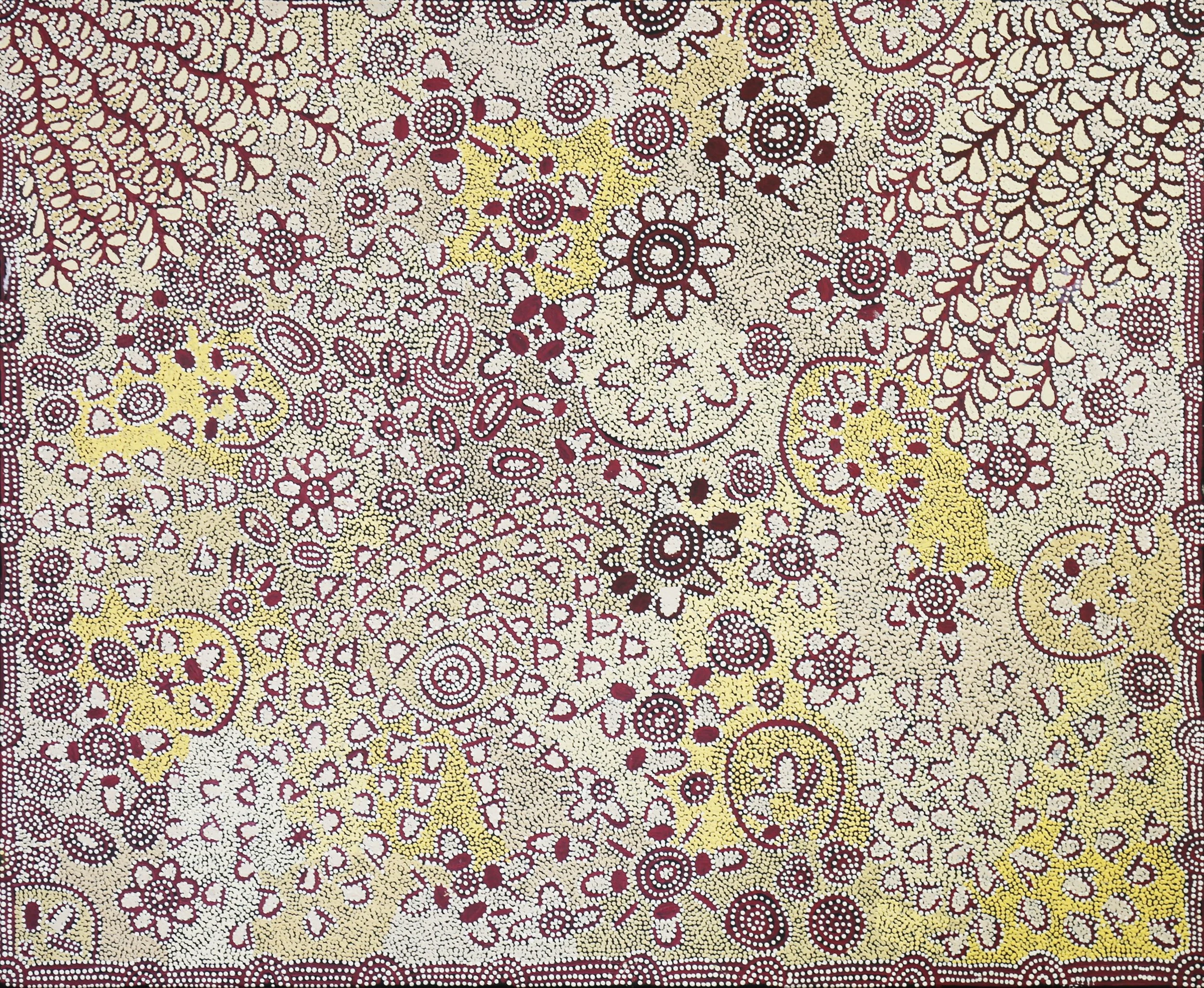
Maryanne Raggett Nungarrayi / Ceremony at M'Bunghara, 2024 #13642-24
91.5 cm x 112 cm Acrylic on Linen
Ceremony on M’Bunghara Creek. The country of M’Bunghara is depicted as a combination of creek and open desert. Maryanne’s ‘landscape’ is scattered with humpies, with people [indicated by U shapes] sitting down around fires [circles surrounded by U shapes], performing Ceremony. This Ceremony is open to all – men, women and children participating.
M’Bunghara, located on M’Bunghara Creek [known as Dashwood Creek] surrounded by Glen Helen Station, is where Maryanne was born to her mother Daisy Leura Nakamarra and father Tim Leura Tjapaltjarri. It is now home to a small Outstation Community of extended family, also called M’Bunghara.
$2050
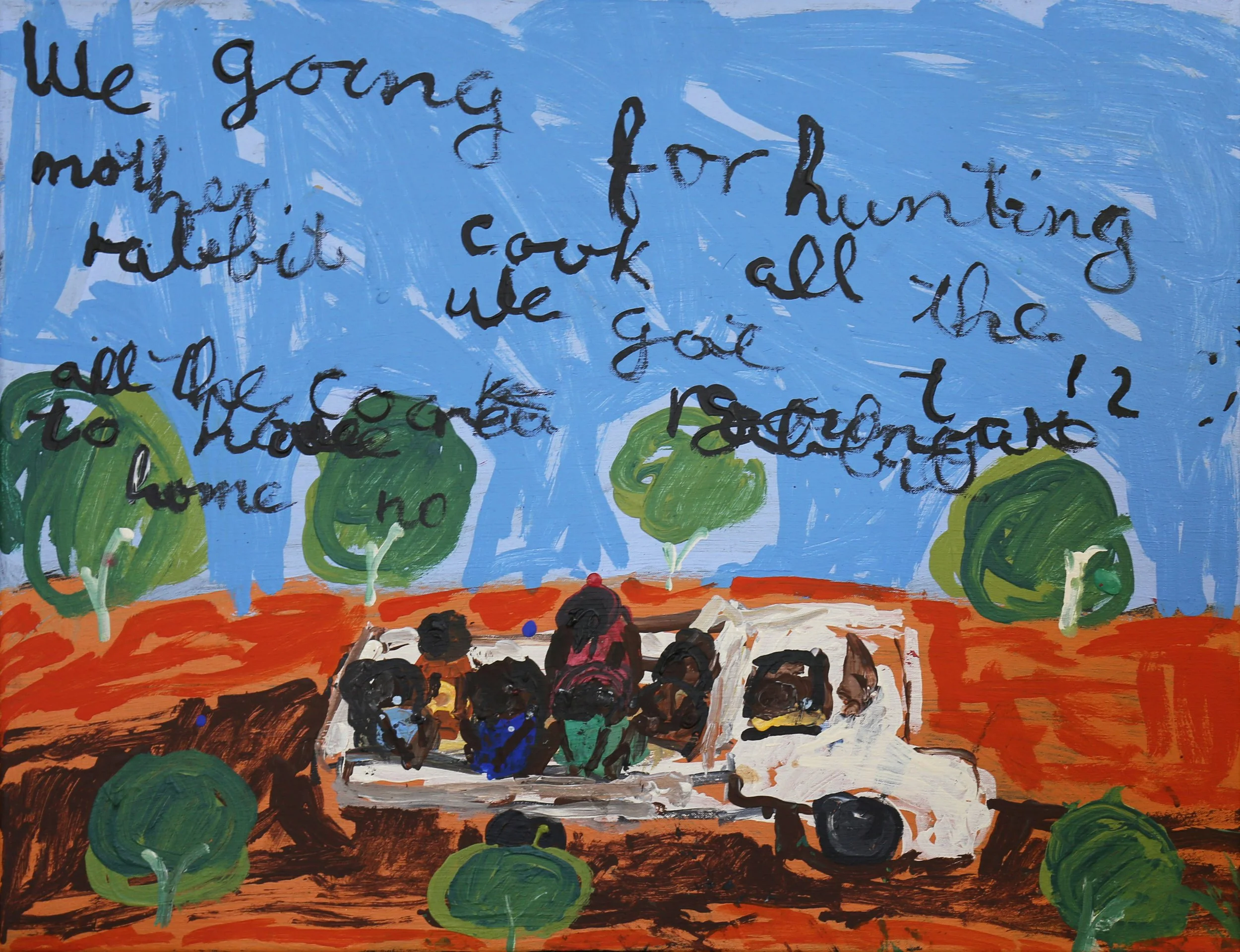
Sally M Nangala Mulda / We going for hunting, 2024 #13488-24
51 cm x 66 cm Acrylic on Linen
‘We going for hunting,
Mother cook all the rabbit, we got 12,
Take all the cooked rabbit to home,
We going home now.
$2,200
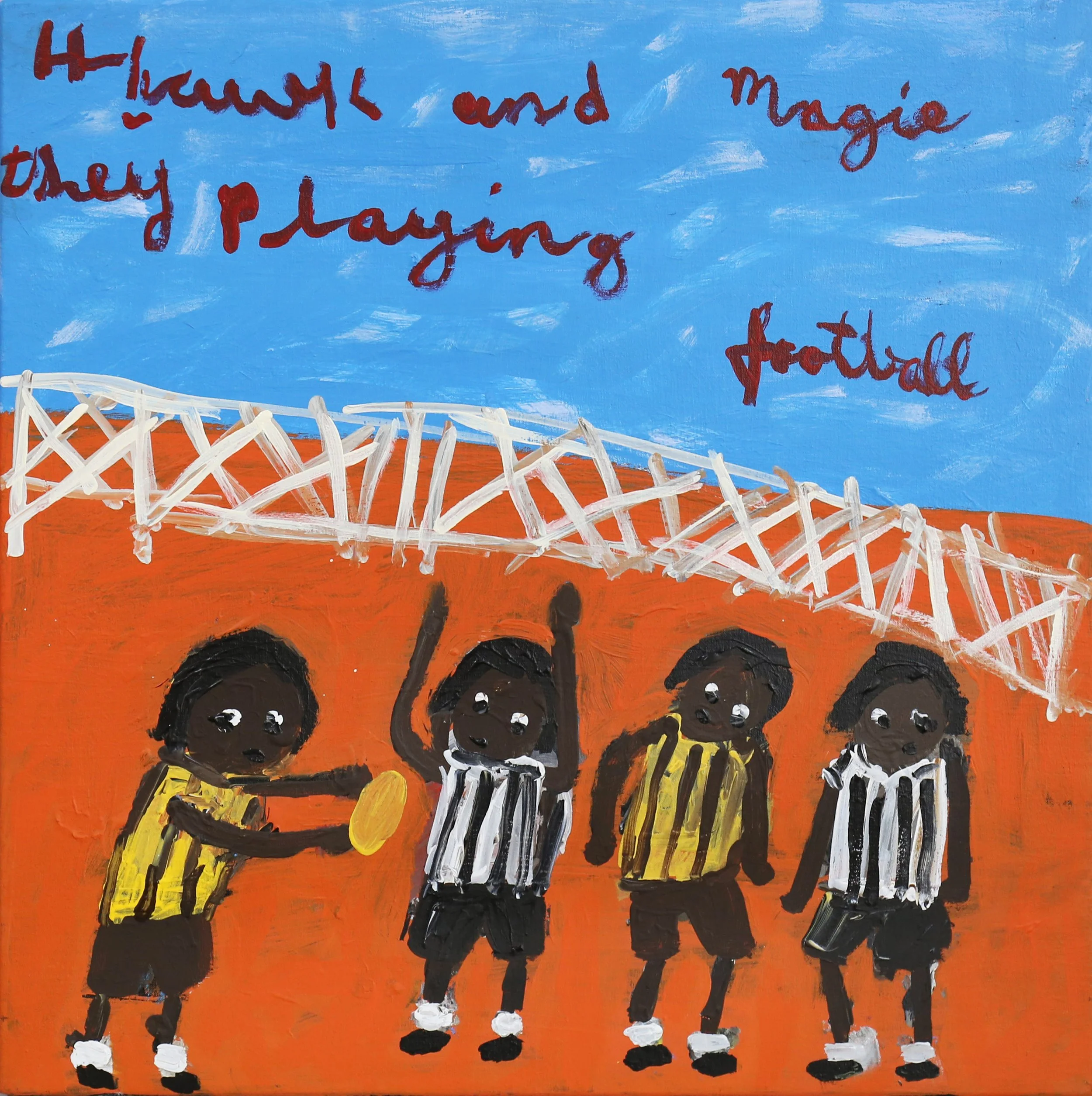
Sally M Nangala Mulda / Hawks and Magpies, 2025 #14204-25
56 cm x 56 cm Acrylic on Linen
Hawks and Magpies they playing football.
SOLD
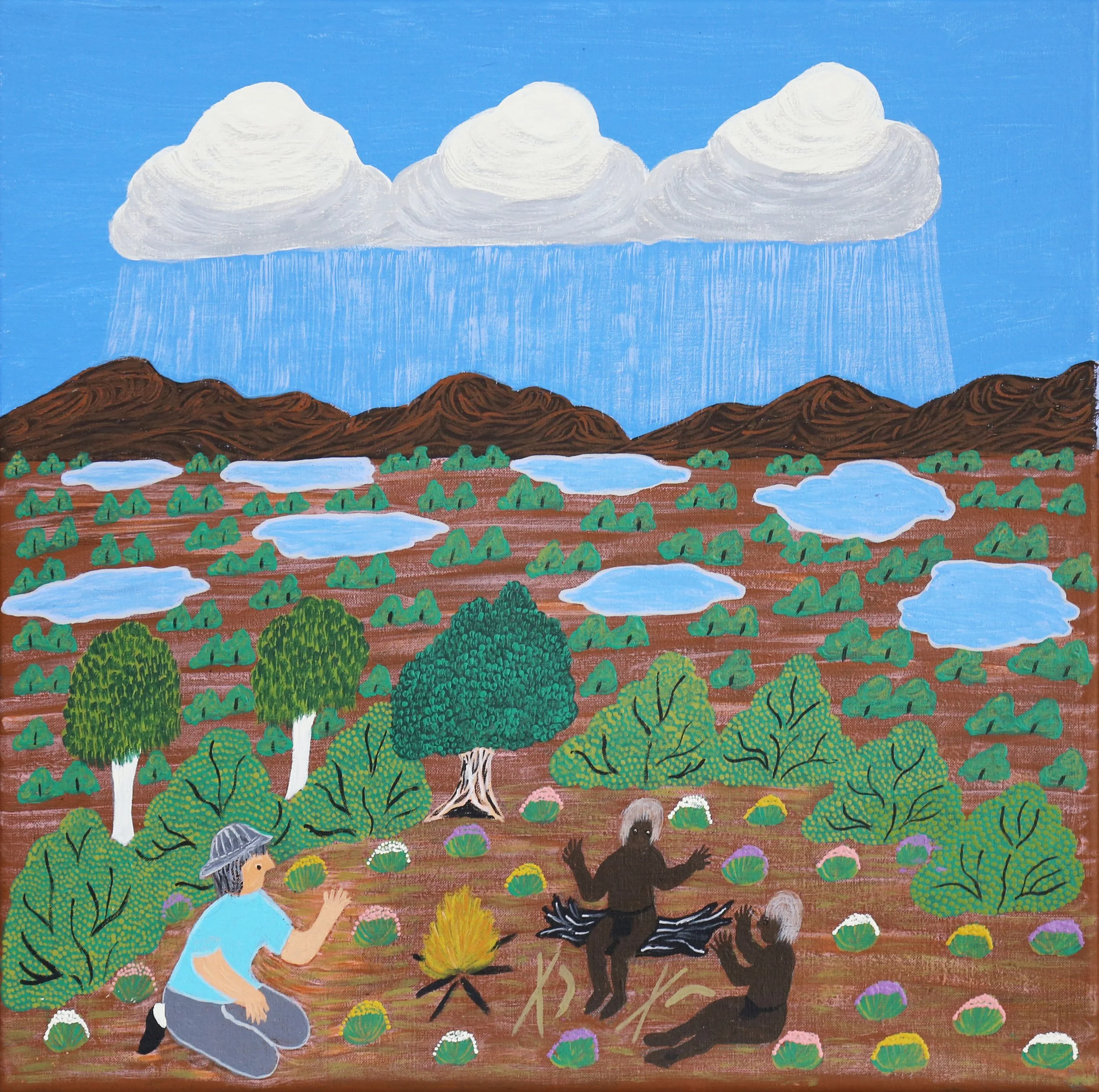
Nora Abbott / Lasseter Story, 2025 #13907-25
51 cm x 51 cm Acrylic on Linen
My grandfather been tell me this when we moved back to his Country round Docker River [1968]. He live there all his life. He was already husband, father. Life was good there – Petermann Ranges… Everyone camp out all the time. All naked. All live in family groups and visit each other across the country. Everywhere group come together for good hunting – Sorry Business – ceremony – celebrations… and then they go back home. They see smoke over there – know family over there, so go visit. Might camp together for overnight, or little while, then back home again. All moving around that Country [Petermann Ranges] back and forth. They follow kapi and bush foods. They all saw Lasseter coming – past Papunya, through the lake [Salt Lake country - Lake Neale], Blood Range way. And they been seen him, white man coming up. They bin never seen white man before. They thought he might be ghost. They were too frightened – on the camel, and Lasseter was looking at them. He was looking round for gold. He had that map, little map… Anangu, they all tell each other what they seen as he went by. Then his camel – two camel – they ran away. He went there to Lasseter’s Cave – Tjunti we call him – that cave he camp. And he stuck there for good. And he used to work with the people now, with Anangu mob, with them together. And he take two young fella look around for two camel that ran from Tjunti. From there they couldn’t find it and they come back home to Tjunti right after. They used to give bush tucker, kangaroo, emu to him, when he ran out of tucker… tucker box empty. Turkey meat, goanna, rabbit - everything – they shared with him. They been get friendly now. He been stop with Anangu now. They all naked. All Lasseter clothes - his shirt - trouse - underwear - all tatters… nothing – just fall away. He stuck for long time with them. Couldn’t go – where would he go? Nowhere to go. Can’t walk too far… stuck there forever.
My grandfather been tell me all this and that. That’s all my grandfather story. This was when my mother was little girl, about this size [five or six year old], and my uncle was baby. Mother remember this time. She tell me that story too from that time, when my uncle was baby. Lasseter there travelling through from Blood Range, then camping at Tjunti for so long. They been look after Lasseter. Then when he passed, big mob Anangu, they buried him. I don’t know where, but old people they know. Grandfather tell me south of Tjunti, that’s Lasseter’s Cave.
Kele, that’s all.
$570

Nora Abbott / Lasseter Story, 2025 #13225-24
66 cm x 66 cm Acrylic on Linen
Lasseter sitting with two good friends. My grandfather been tell me this when we moved back to his Country round Docker River [1968]. He live there all his life. He was already husband, father. Life was good there – Petermann Ranges… Everyone camp out all the time. All naked. All live in family groups and visit each other across the country. Everywhere group come together for good hunting – Sorry Business – ceremony – celebrations… and then they go back home. They see smoke over there – know family over there, so go visit. Might camp together for overnight, or little while, then back home again. All moving around that Country [Petermann Ranges] back and forth. They follow kapi and bush foods. They all saw Lasseter coming – past Papunya, through the lake [Salt Lake country - Lake Neale], Blood Range way. And they been seen him, white man coming up. They bin never seen white man before. They thought he might be ghost. They were too frightened – on the camel, and Lasseter was looking at them. He was looking round for gold. He had that map, little map… Anangu, they all tell each other what they seen as he went by. Then his camel – two camel – they ran away. He went there to Lasseter’s Cave – Tjunti we call him – that cave he camp. And he stuck there for good. And he used to work with the people now, with Anangu mob, with them together. And he take two young fella look around for two camel that ran from Tjunti. From there they couldn’t find it and they come back home to Tjunti right after. They used to give bush tucker, kangaroo, emu to him, when he ran out of tucker… tucker box empty. Turkey meat, goanna, rabbit - everything – they shared with him. They been get friendly now. He been stop with Anangu now. They all naked. All Lasseter clothes - his shirt - trouse - underwear - all tatters… nothing – just fall away. He stuck for long time with them. Couldn’t go – where would he go? Nowhere to go. Can’t walk too far… stuck there forever.
My grandfather been tell me all this and that. That’s all my grandfather story. This was when my mother was little girl, about this size [five or six year old], and my uncle was baby. Mother remember this time. She tell me that story too from that time, when my uncle was baby. Lasseter there travelling through from Blood Range, then camping at Tjunti for so long. They been look after Lasseter. Then when he passed, big mob Anangu, they buried him. I don’t know where, but old people they know. Grandfather tell me south of Tjunti, that’s Lasseter’s Cave.
Kele, that’s all.
$960
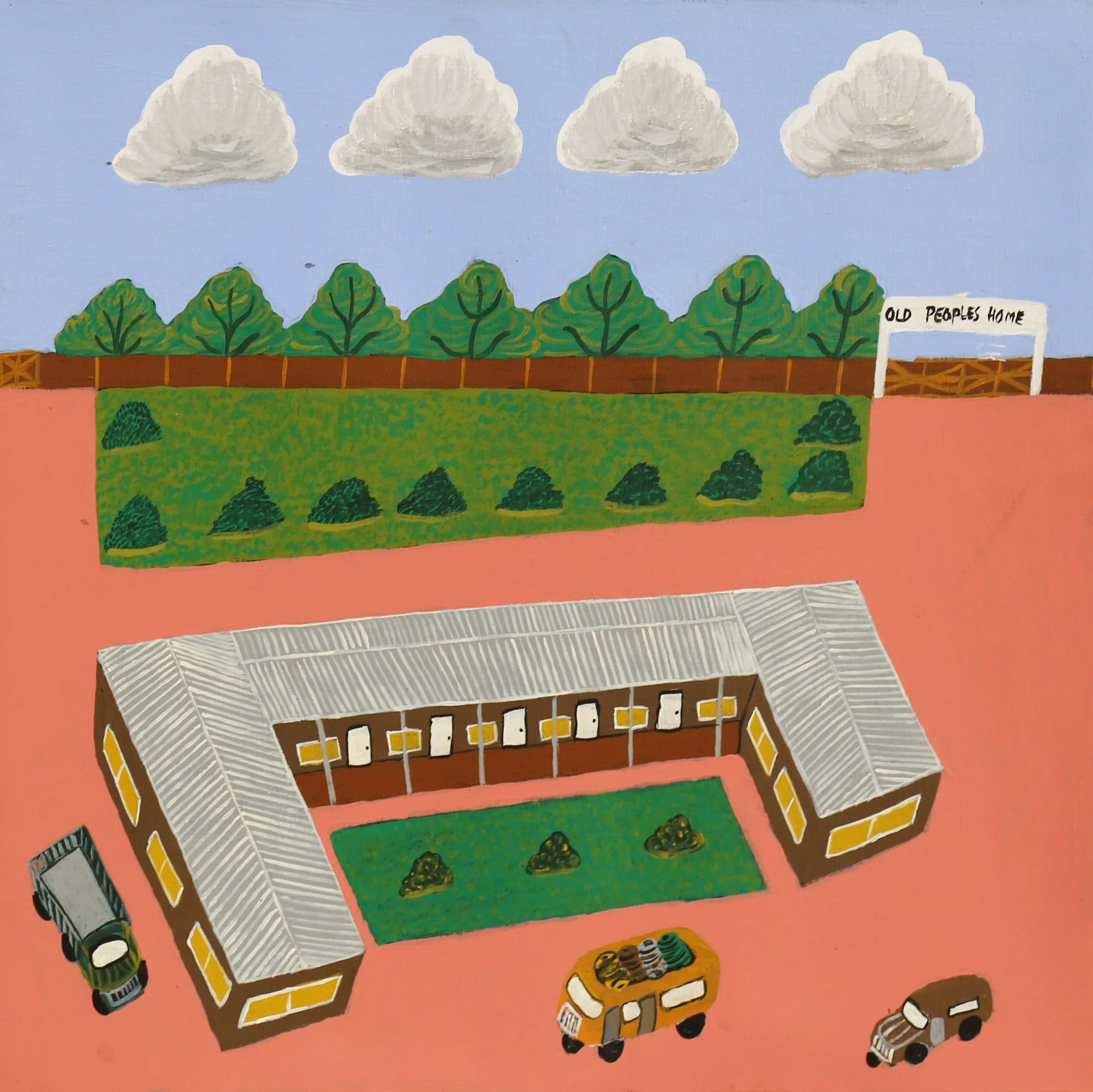
Nora Abbott / Old People's Home, 2025 #14273-25
56 cm x 56 cm Acrylic on Linen
Old People's Home, Docker River
$600

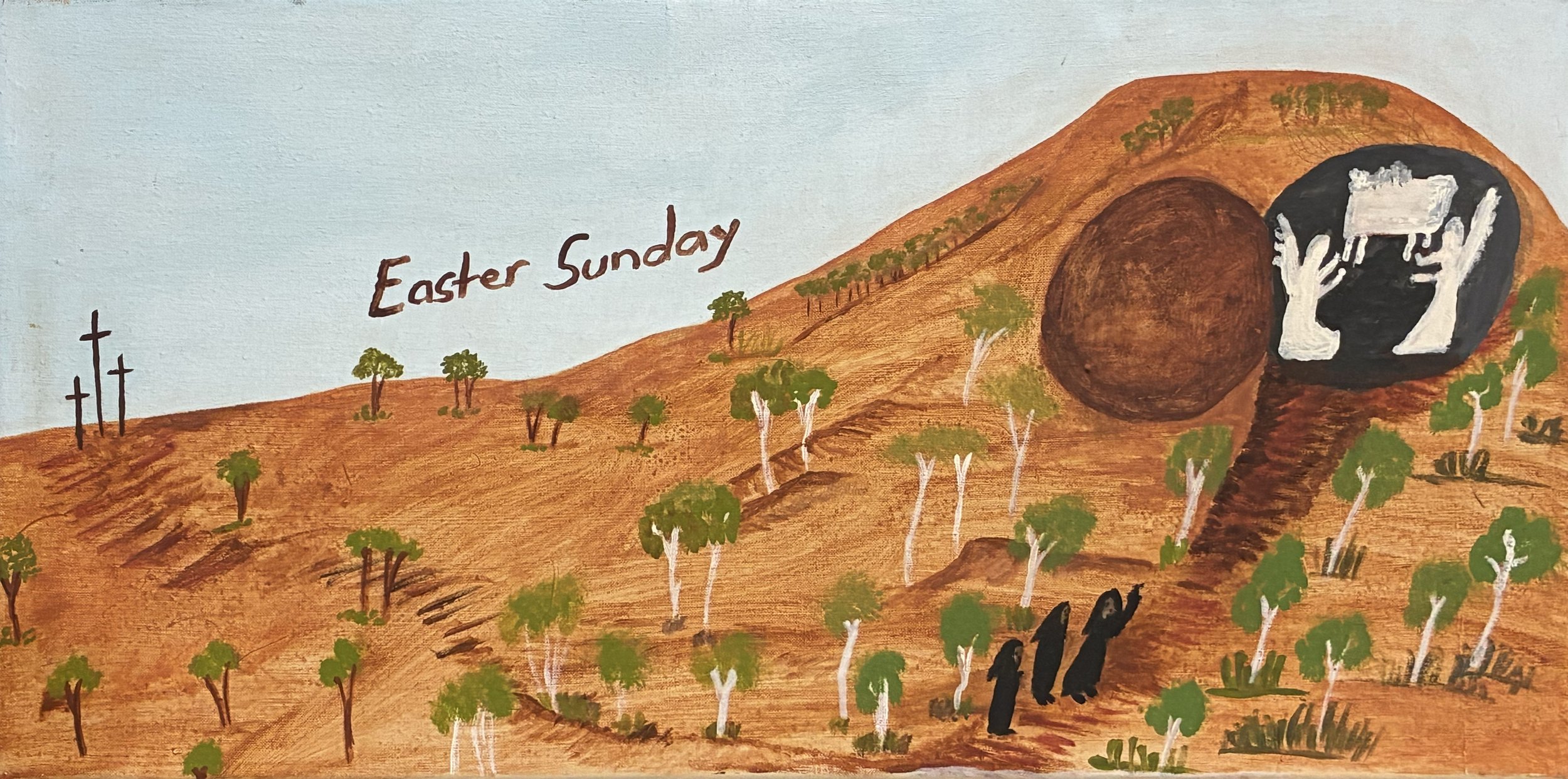
N Kunmanara Donald / Easter Sunday, 2025 #14248-25
30.5 cm x 61 cm Acrylic on Linen
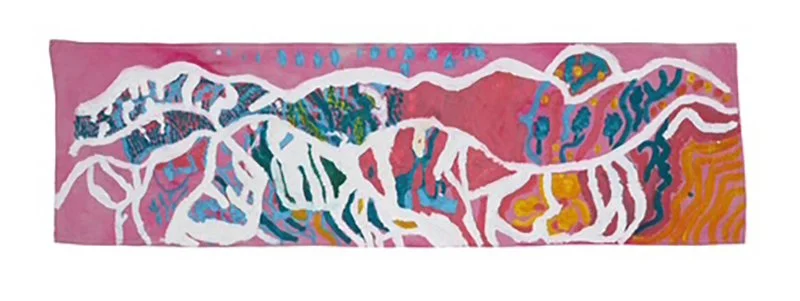
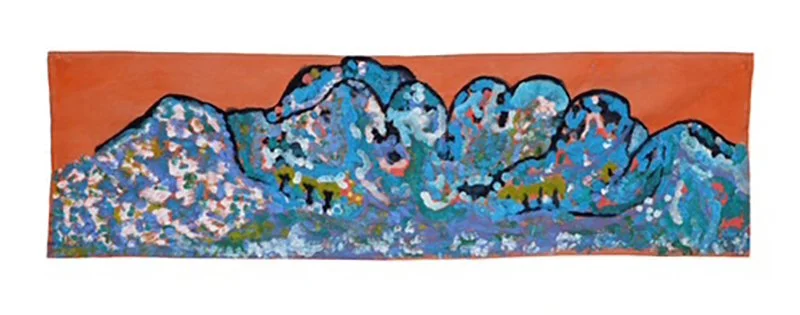
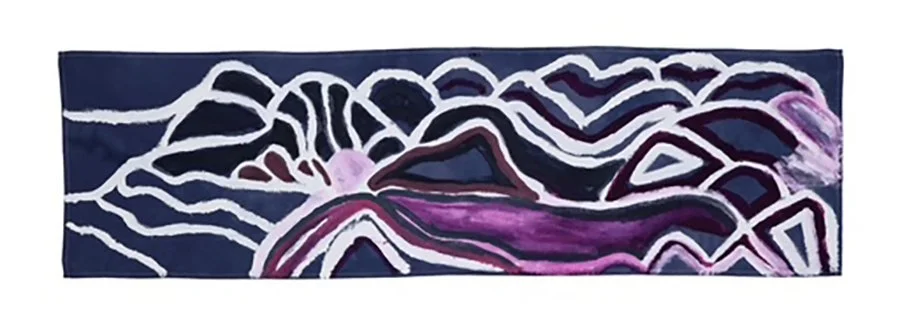
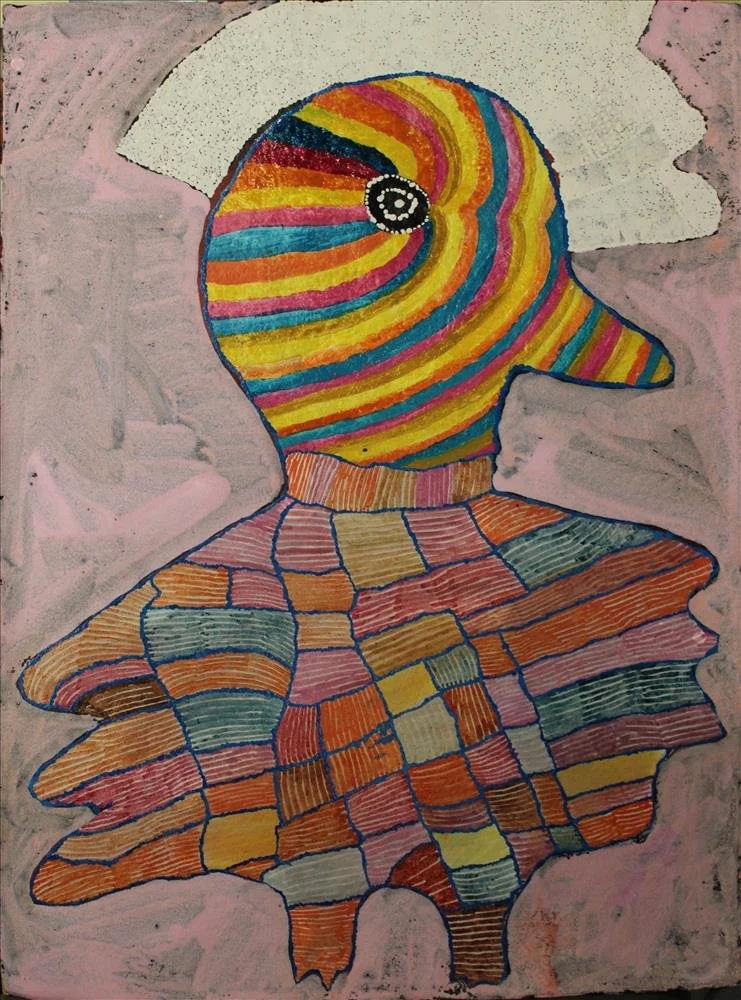
On Easter Sunday morning, Mary Magdalene went to Jesus’ tomb and found it empty. At first, she was sad and confused, but then Jesus appeared to her, alive. Filled with joy, she ran to tell His friends that He had risen from the dead.
$380

N Kumanara Donald / Utju (Areyonga) Community, 2025 #14095-25
90 x 90 cm Acrylic on Linen
‘Map of Utju (Areyonga) community.’
$2,000
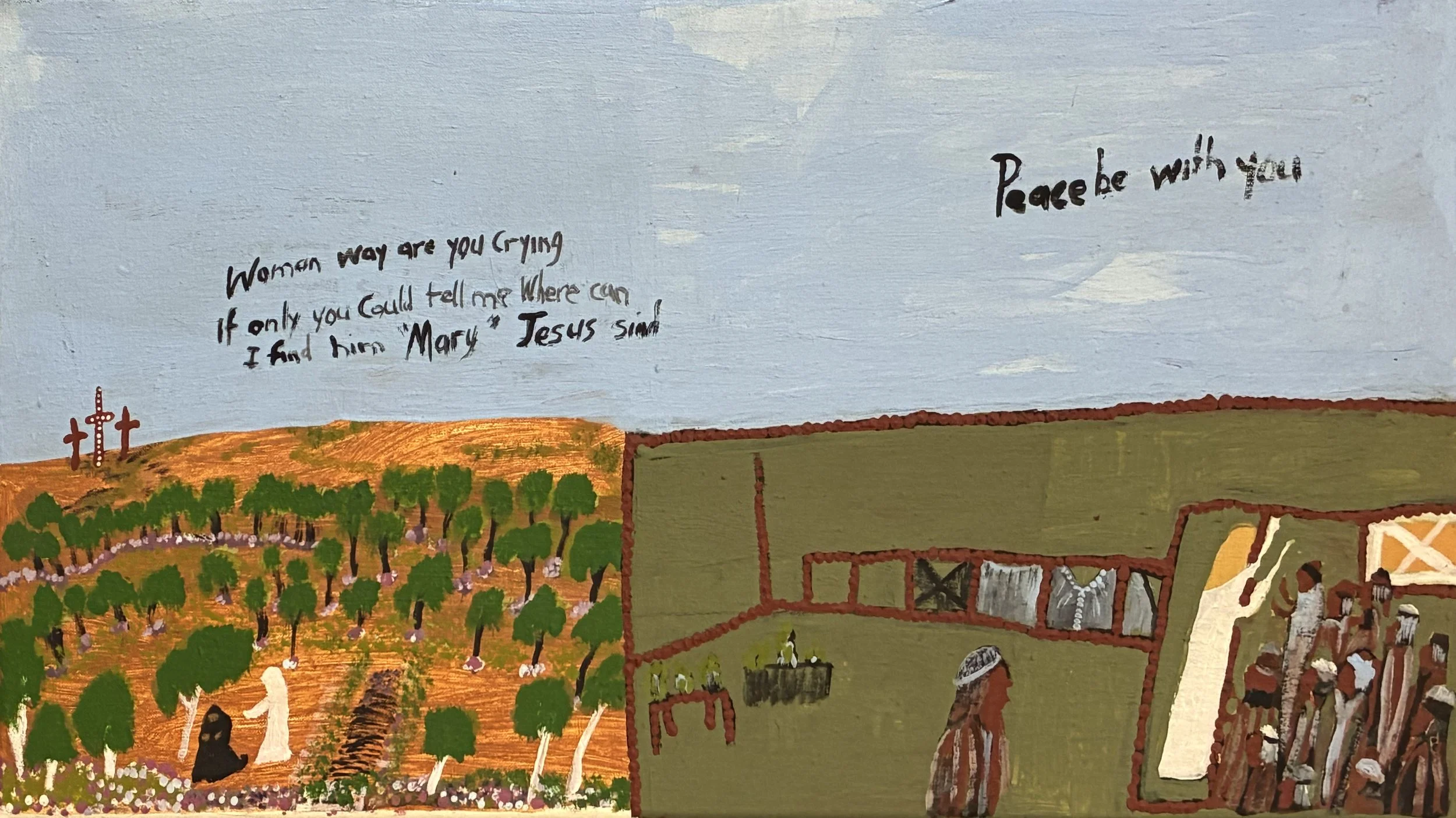
N Kunmanara Donald / Easter Story, 2025 /#14245-25
30.5 cm x 61 cm Acrylic on Linen
‘Mary's crying outside the tomb & Jesus came out and asked 'why are you crying?' Mary though he was a gardener. 'If you could only tell me where my lord is...I could take him home, so I can care for him.' He called her name & she turned around and touched him. He was no longer flesh. He sent her to tell his disciples that he had risen, that's the good news of the Easter Story.’
$380
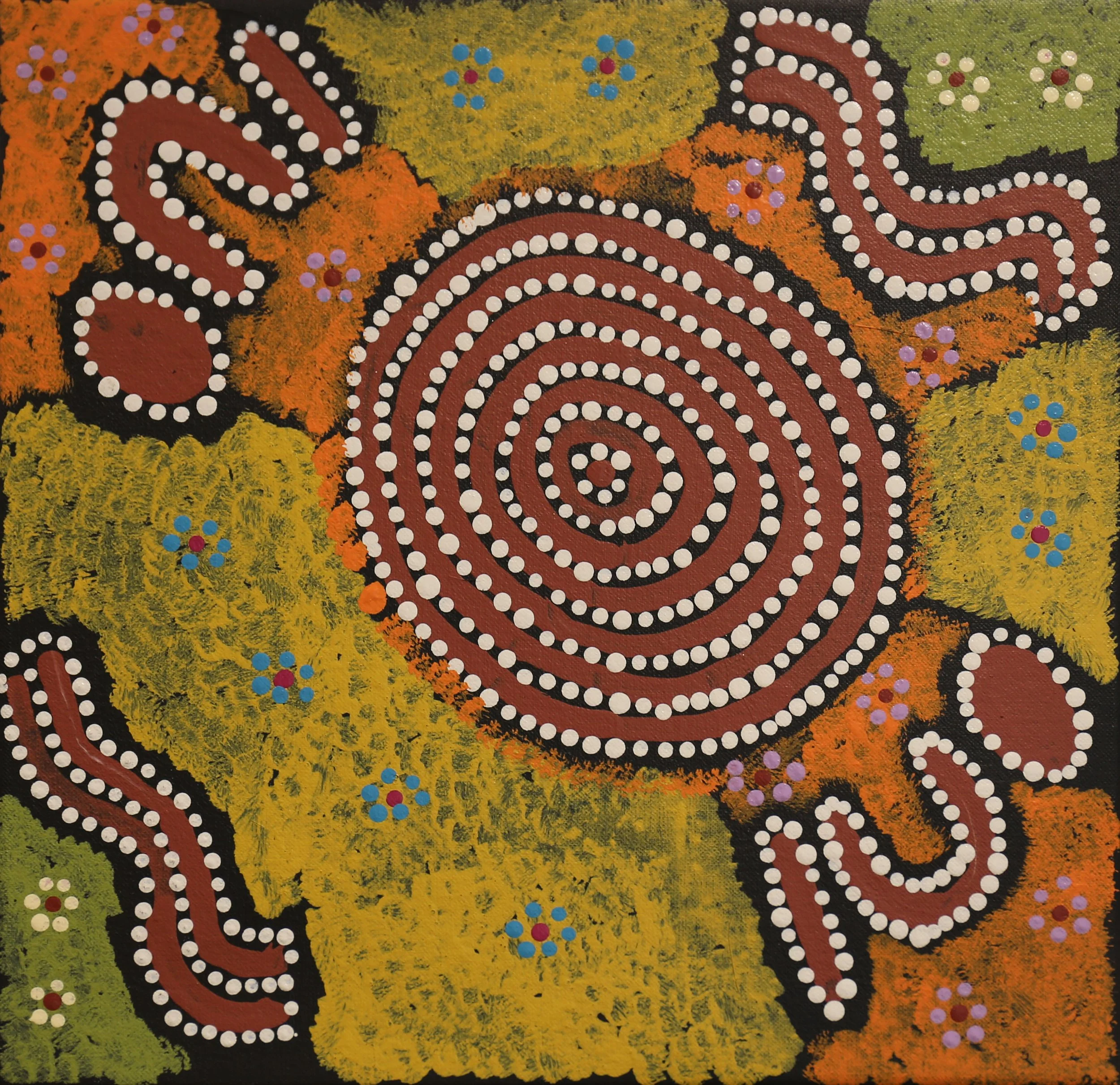
April Spencer Napaltjarri / Wardapi Jukurrpa, 2025 #14280-25
30.5 cm x 30.5 cm Acrylic on Linen
'This painting is about the way women hunt Wardapi – that sand goanna. He digs holes in the dunes, makes his nest deep inside. Many of the holes all join up. Women hunt Wardapi in the dunes by digging out the holes. Sometimes cover one, and Wardapi runs out other one. Need to hunt him together. Find all the holes. Dig them at the same time. Someone going to get him that way.’
The Wardapi Jukurrpa [Varanus Gouldii Goanna] belongs to the Spencer Sisters. It comes from Yarripilangku [aka Yinyiripalangu], south-west of Yuendumu. A group of Warlpiri Karnta [women] are sitting down in a circle when a Japangardi Wati [man] from Puturlu [Mt Theo], called Wamaru came upon them. He wants to take one of them, named Yurlkurinyi, of Nungarrayi skin, which is the wrong skin for him. He takes the Nungarrayi woman up a hill, where they make love. In response, the earth on top of the hill turns to Ngunjungunju [white ochre], and yellow and red ochre. The yellow is for Karnta and the red for Wati. The ochre is used by Warlpiri people for love magic and ceremonial decoration. The Wati turns all the Karnta and himself into Wardapi, aka Varanus Gouldii goannas. This Jukurrpa belongs to the Napaljarri/Japaljarri and Nungarrayi /Jungarrayi subsections, and the Japanangka/Napanangka, Japangardi/Napangardi subsections of Puturlu. The women are often represented by ‘U’ shapes. Concentric circles may illustrate Wardapi holes, or their droppings left behind them, and Wardapi tracks are usually represented by ‘W’ shapes and wavy lines.’
$200 on stretcher
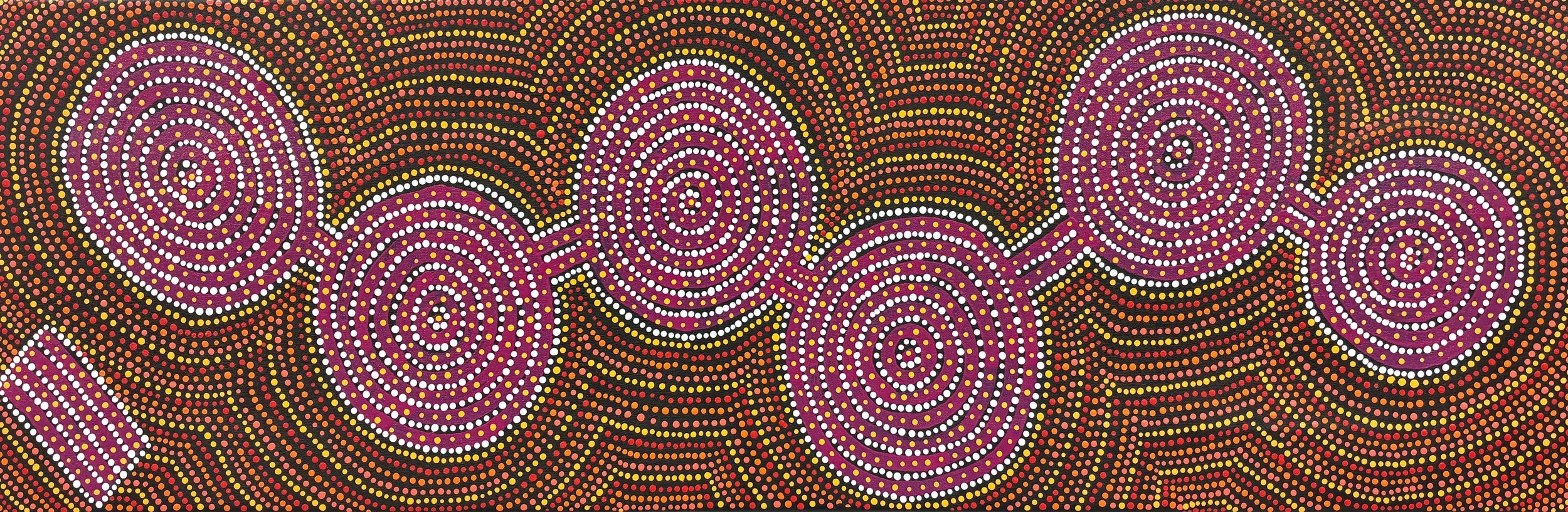
April Spencer Napaltjarri / Wardapi Jukurrpa, 2025 #14240-25
38.5 cm x 119 cm Acrylic on Linen
'This painting is about the way women hunt Wardapi – that sand goanna. He digs holes in the dunes, makes his nest deep inside. Many of the holes all join up. Women hunt Wardapi in the dunes by digging out the holes. Sometimes cover one, and Wardapi runs out other one. Need to hunt him together. Find all the holes. Dig them at the same time. Someone going to get him that way.’
The Wardapi Jukurrpa [Varanus Gouldii Goanna] belongs to the Spencer Sisters. It comes from Yarripilangku [aka Yinyiripalangu], south-west of Yuendumu. A group of Warlpiri Karnta [women] are sitting down in a circle when a Japangardi Wati [man] from Puturlu [Mt Theo], called Wamaru came upon them. He wants to take one of them, named Yurlkurinyi, of Nungarrayi skin, which is the wrong skin for him. He takes the Nungarrayi woman up a hill, where they make love. In response, the earth on top of the hill turns to Ngunjungunju [white ochre], and yellow and red ochre. The yellow is for Karnta and the red for Wati. The ochre is used by Warlpiri people for love magic and ceremonial decoration. The Wati turns all the Karnta and himself into Wardapi, aka Varanus Gouldii goannas. This Jukurrpa belongs to the Napaljarri/Japaljarri and Nungarrayi /Jungarrayi subsections, and the Japanangka/Napanangka, Japangardi/Napangardi subsections of Puturlu. The women are often represented by ‘U’ shapes. Concentric circles may illustrate Wardapi holes, or their droppings left behind them, and Wardapi tracks are usually represented by ‘W’ shapes and wavy lines.’
$730
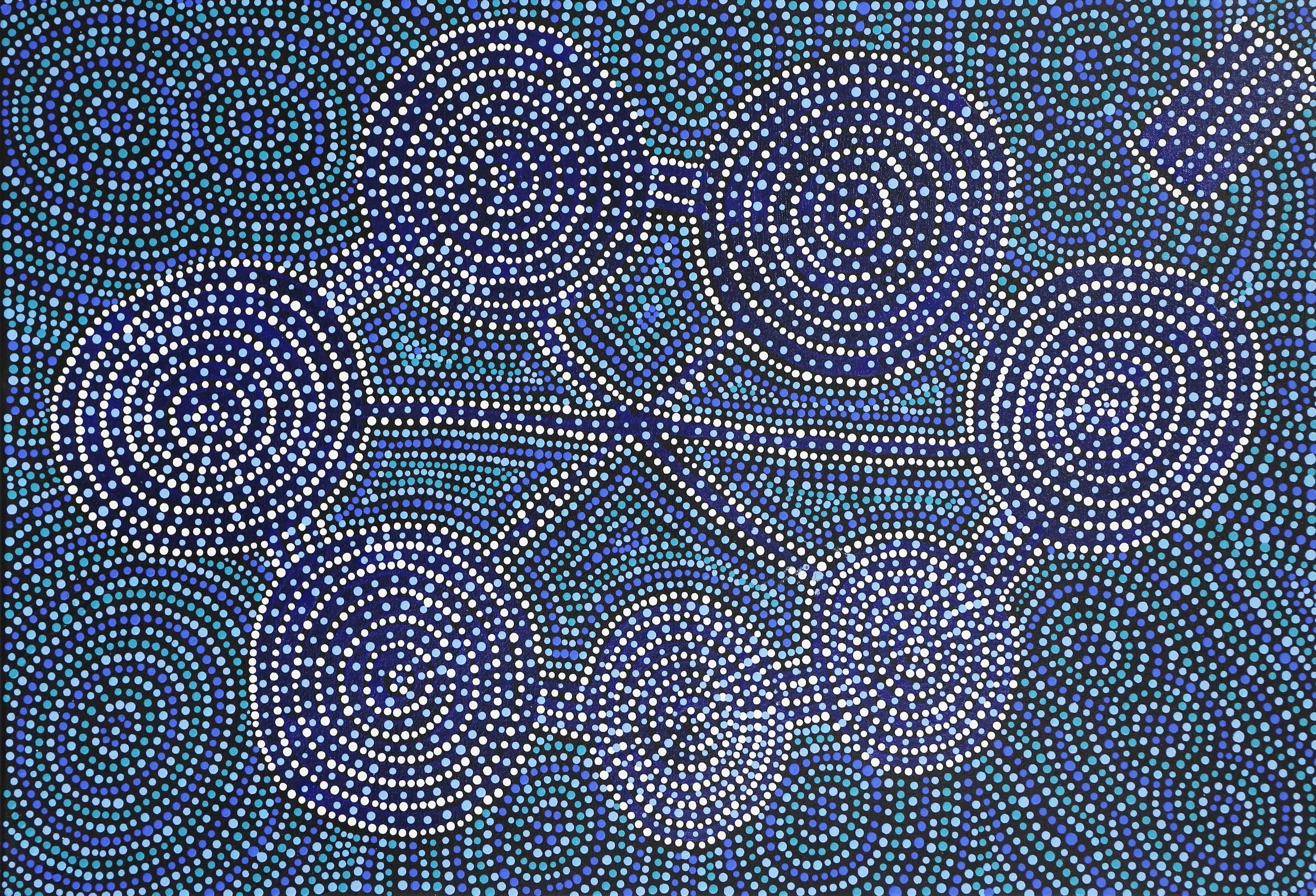
April Spencer Napaltjarri / Wardapi Jukurrpa, 2025 #14194-25
51.5 cm x 74.5 cm Acrylic on Linen
'This painting is about the way women hunt Wardapi – that sand goanna. He digs holes in the dunes, makes his nest deep inside. Many of the holes all join up. Women hunt Wardapi in the dunes by digging out the holes. Sometimes cover one, and Wardapi runs out other one. Need to hunt him together. Find all the holes. Dig them at the same time. Someone going to get him that way.’
The Wardapi Jukurrpa [Varanus Gouldii Goanna] belongs to the Spencer Sisters. It comes from Yarripilangku [aka Yinyiripalangu], south-west of Yuendumu. A group of Warlpiri Karnta [women] are sitting down in a circle when a Japangardi Wati [man] from Puturlu [Mt Theo], called Wamaru came upon them. He wants to take one of them, named Yurlkurinyi, of Nungarrayi skin, which is the wrong skin for him. He takes the Nungarrayi woman up a hill, where they make love. In response, the earth on top of the hill turns to Ngunjungunju [white ochre], and yellow and red ochre. The yellow is for Karnta and the red for Wati. The ochre is used by Warlpiri people for love magic and ceremonial decoration. The Wati turns all the Karnta and himself into Wardapi, aka Varanus Gouldii goannas. This Jukurrpa belongs to the Napaljarri/Japaljarri and Nungarrayi /Jungarrayi subsections, and the Japanangka/Napanangka, Japangardi/Napangardi subsections of Puturlu. The women are often represented by ‘U’ shapes. Concentric circles may illustrate Wardapi holes, or their droppings left behind them, and Wardapi tracks are usually represented by ‘W’ shapes and wavy lines.’
$540
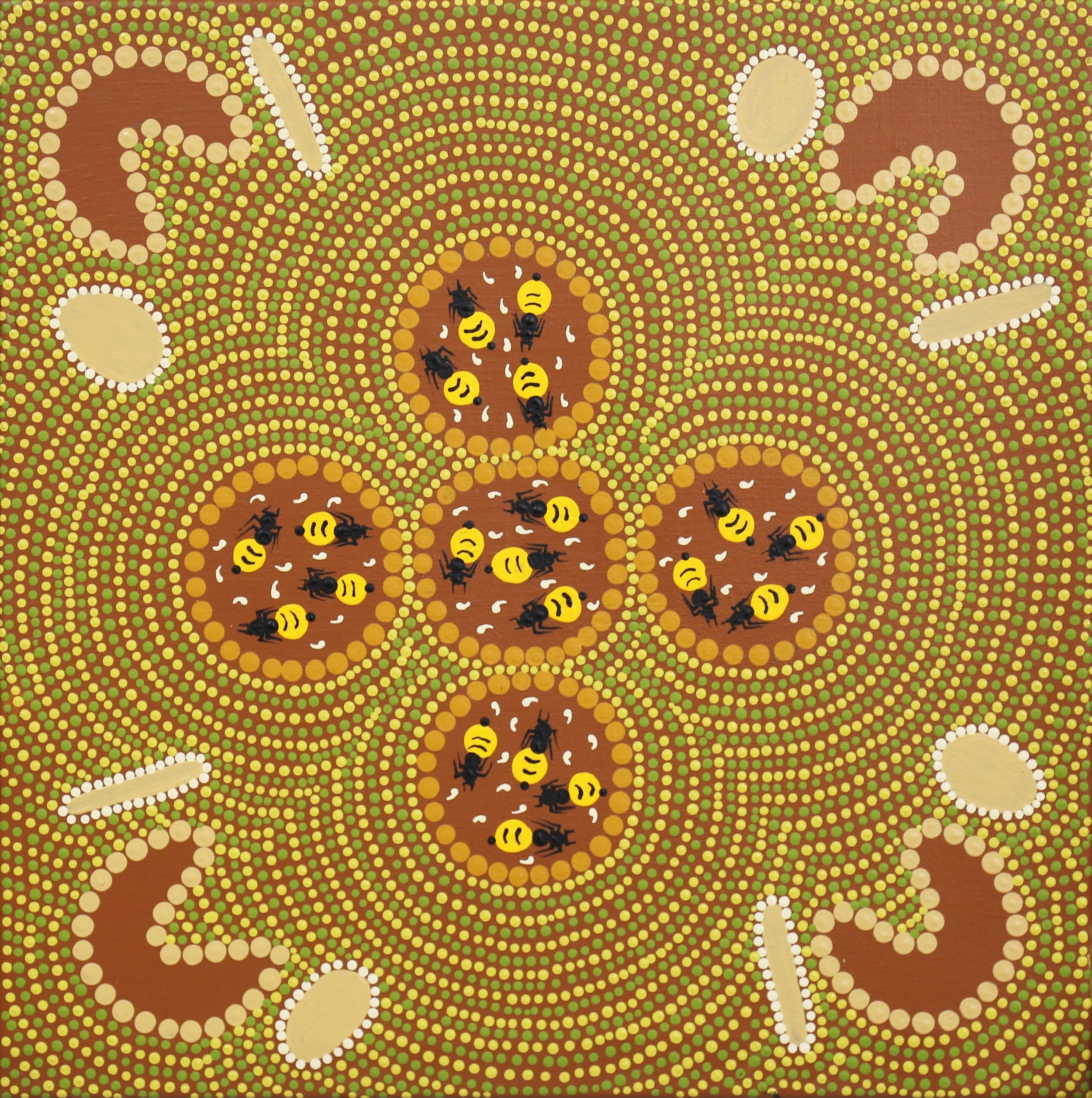
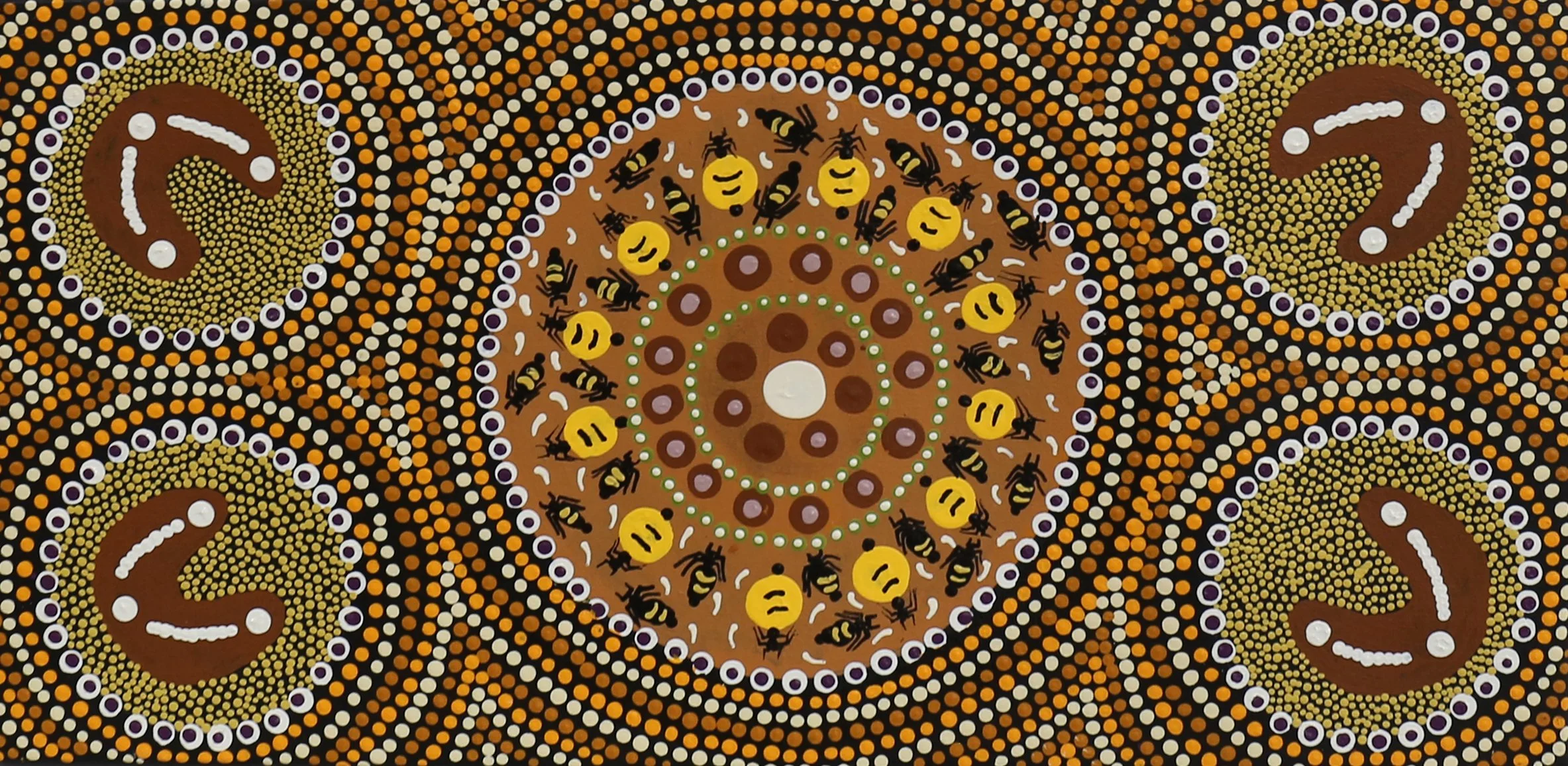
Helen Gillen / Women Digging for Honey Ants, 2025 #14071-25
51 cm x 51 cm Acrylic on Linen
Women planning their dig for Honey Ants. Honey Ants hang from the ceiling of chambers their family dig out of the earth. The tunnels into the chambers are long and complex. That means the Honey Ants have to be tracked, and then the women use informed guesswork based on experience to decide where to dig. The process can take hours of very hard work, but the ladies are always completely rewarded when they find those delicious ants whose abdomens are full of sweet honey.
$350
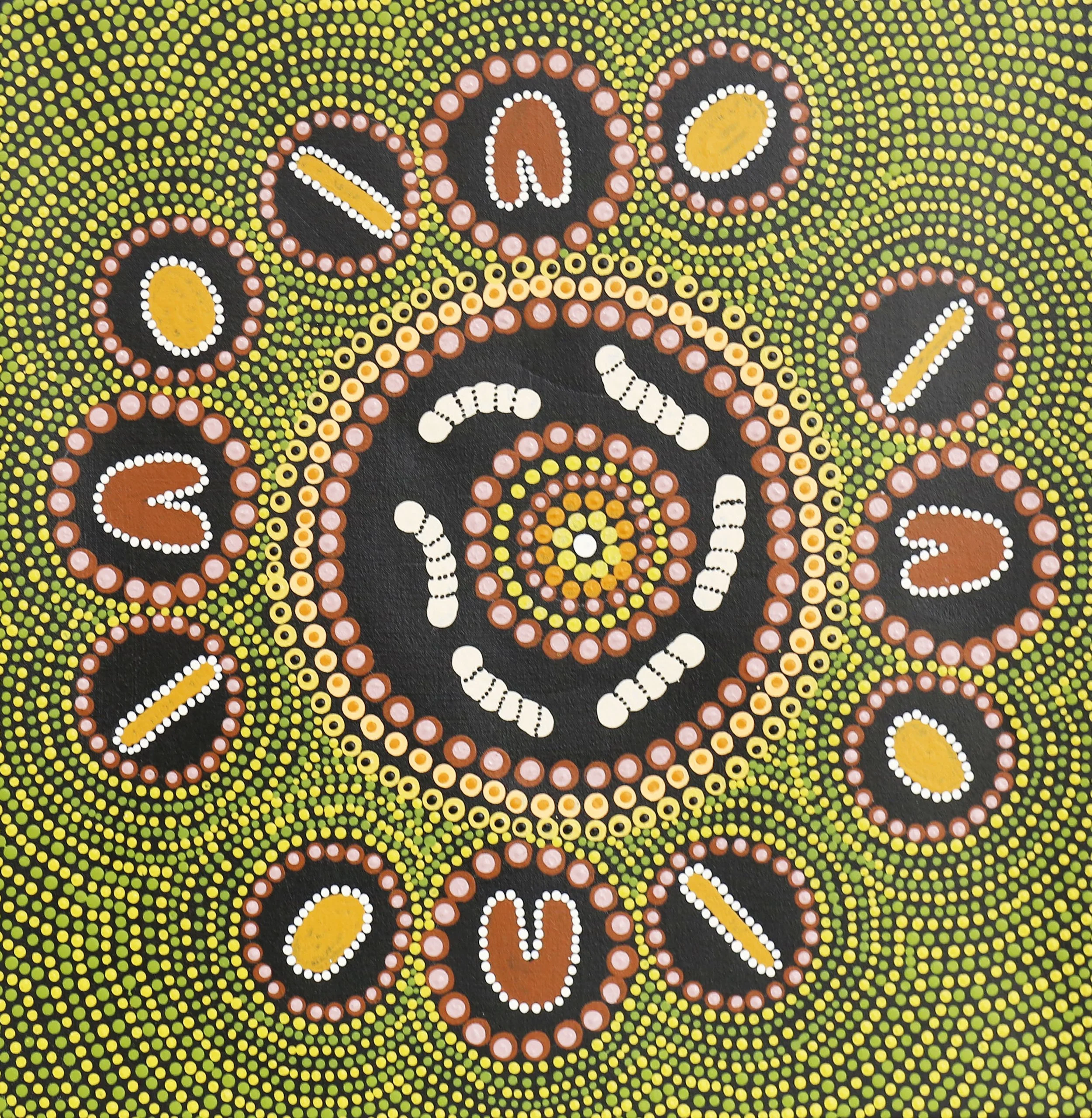
Helen Gillen / Women Digging for Honey Ants, 2025 #14276-25
30.5 cm x 61 cm Acrylic on Linen
Women planning their dig for Honey Ants. Honey Ants hang from the ceiling of chambers their family dig out of the earth. The tunnels into the chambers are long and complex. That means the Honey Ants have to be tracked, and then the women use informed guesswork based on experience to decide where to dig. The process can take hours of very hard work, but the ladies are always completely rewarded when they find those delicious ants whose abdomens are full of sweet honey.
$300
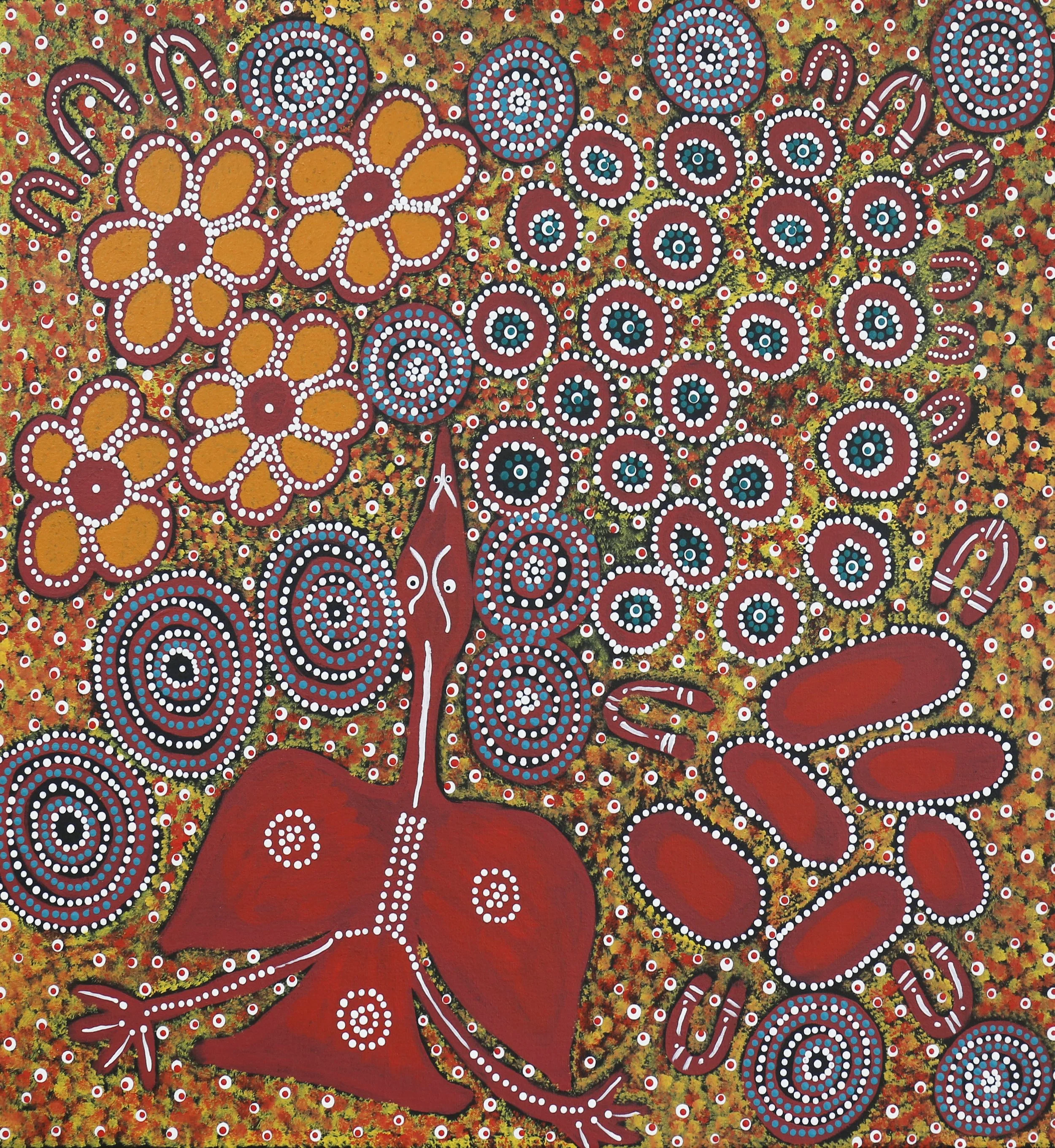
Helen Gillen / Women Digging for Honey Ants, 2025 #14188-25
56 cm x 56 cm Acrylic on Linen
Women planning their dig for Honey Ants. Honey Ants hang from the ceiling of chambers their family dig out of the earth. The tunnels into the chambers are long and complex. That means the Honey Ants have to be tracked, and then the women use informed guesswork based on experience to decide where to dig. The process can take hours of very hard work, but the ladies are always completely rewarded when they find those delicious ants whose abdomens are full of sweet honey.
$440
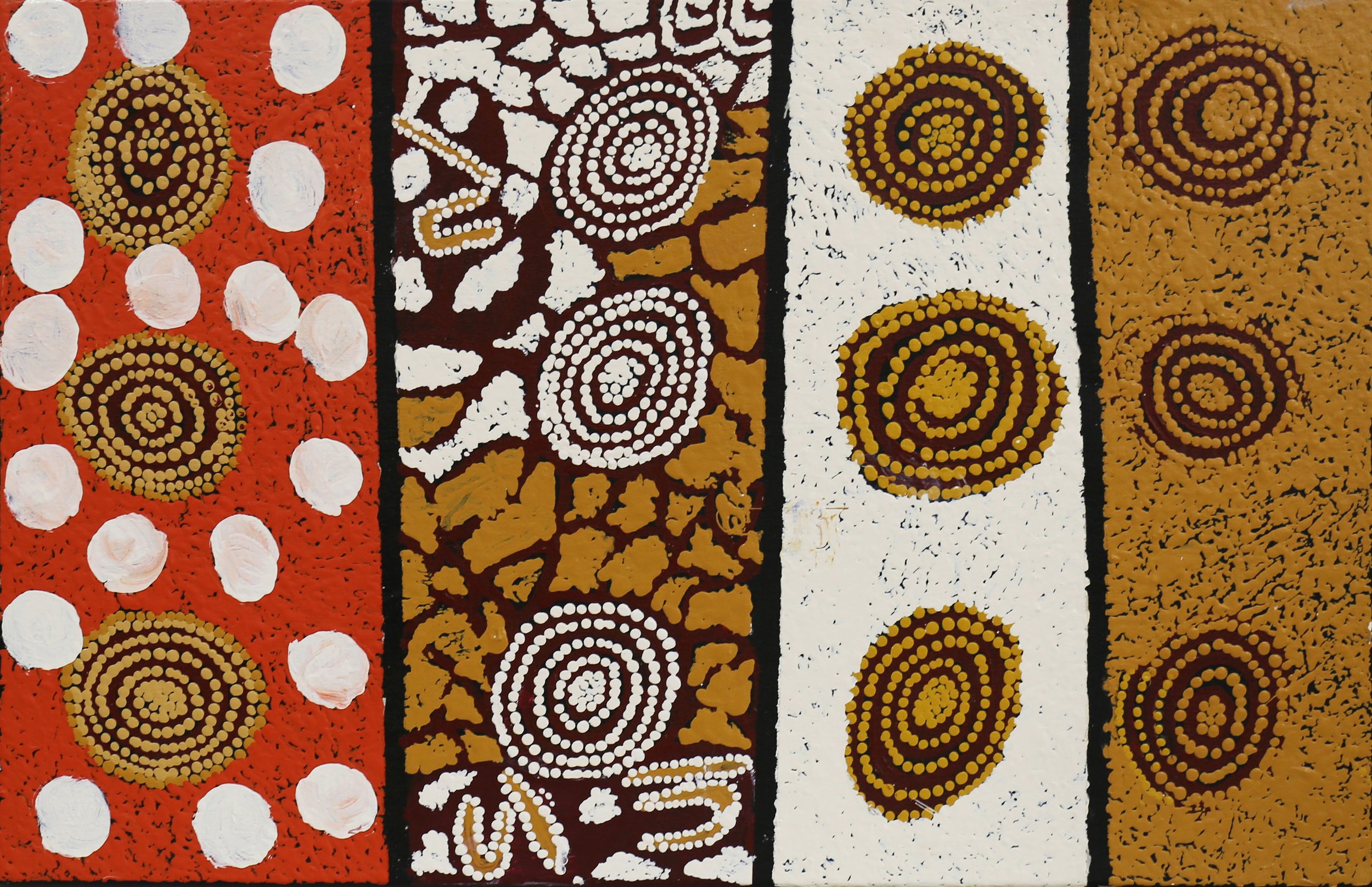
Marlene Taylor / Kipara (Bush Turkey), 2025 #14162-25
66 cm x 66 cm Acrylic on Linen
In this painting, the ‘U’ shapes represent women sitting down on country, gathered together for ceremony and for collecting bush foods. Beside them are red oval shapes, showing the wild potato, a traditional bush tucker that grows beneath the desert soil. These are carefully dug up, cleaned, and cooked in the fire until they become soft and a little bit sweet — a favourite food shared among family.
The concentric circles scattered across the painting show the holes dug by children as they search for bush potatoes and play in the sand. Around these holes, yellow wildflowers bloom brightly after rain, spreading across the country and bringing colour to the dry land.
The story also includes the Kipara (wild turkey), a bird that moves carefully through the spinifex and open country. Families hunt and cook the Kipara, continuing a long tradition of living from and caring for the land.
$700
Maggie Nakamarra Corby / Inma - Three Sisters Ceremony , 2025 #14160-25
50 cm x 78.5 cm Acrylic on Linen
'This one Inma - Three Sisters Ceremony - painted up dancing close - all painted with ochre - white feather bound to forehead.'
$600
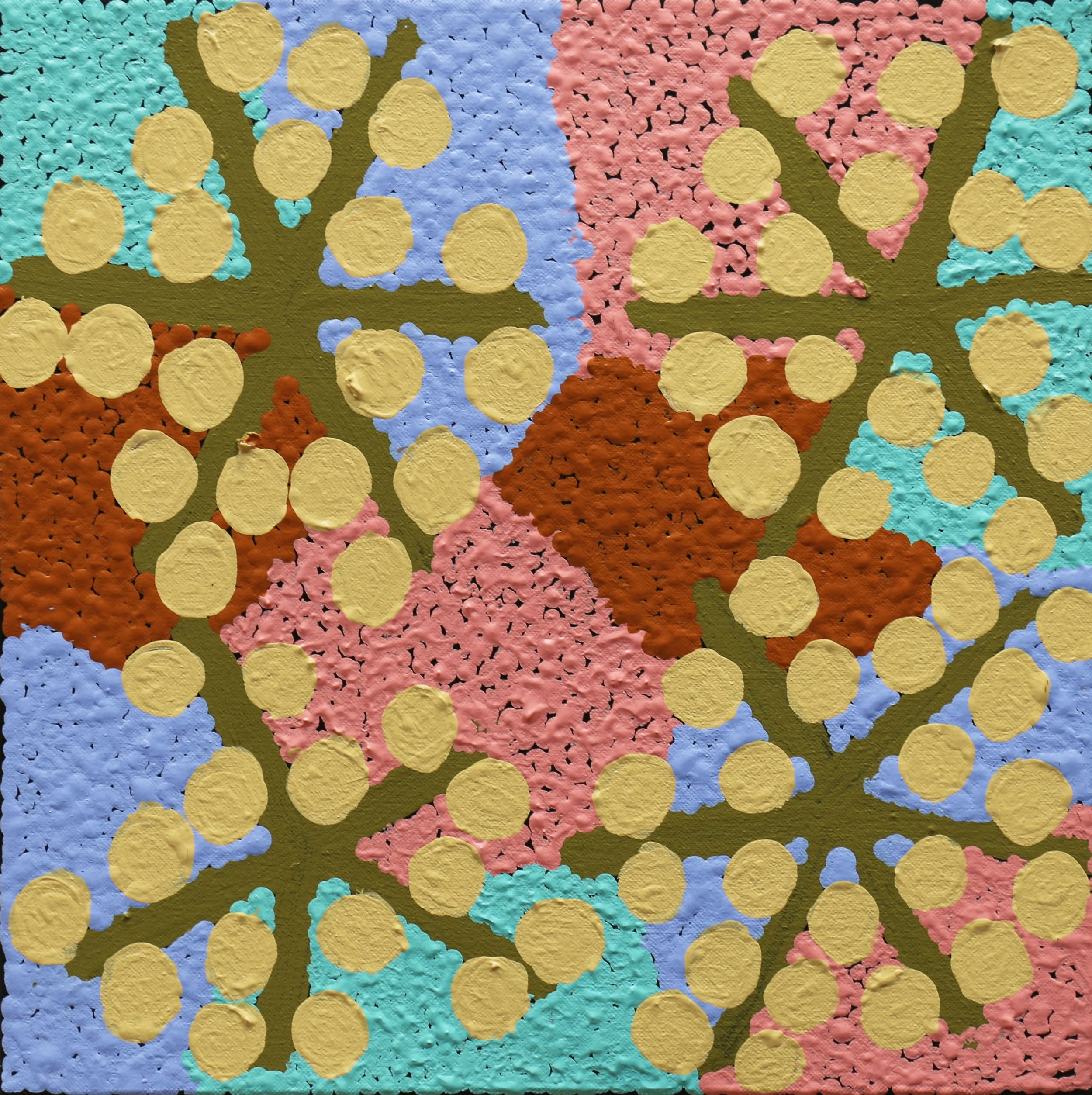
Isobelle Spencer Napaljarri / Watiyawarnu, 2025 #14284-25
30 cm x 30 cm Acrylic on Linen
Women collecting Watiyawarnu (Acacia tenuissima). Back at camp after collecting the seeds they make large windbreaks for shelter and winnow the seed in the late afternoon. Immature watiyawarnu seed is ground into a paste and can be used to treat upset stomachs. There is an important ceremony for this Tjukurrpa.
$150 on stretcher
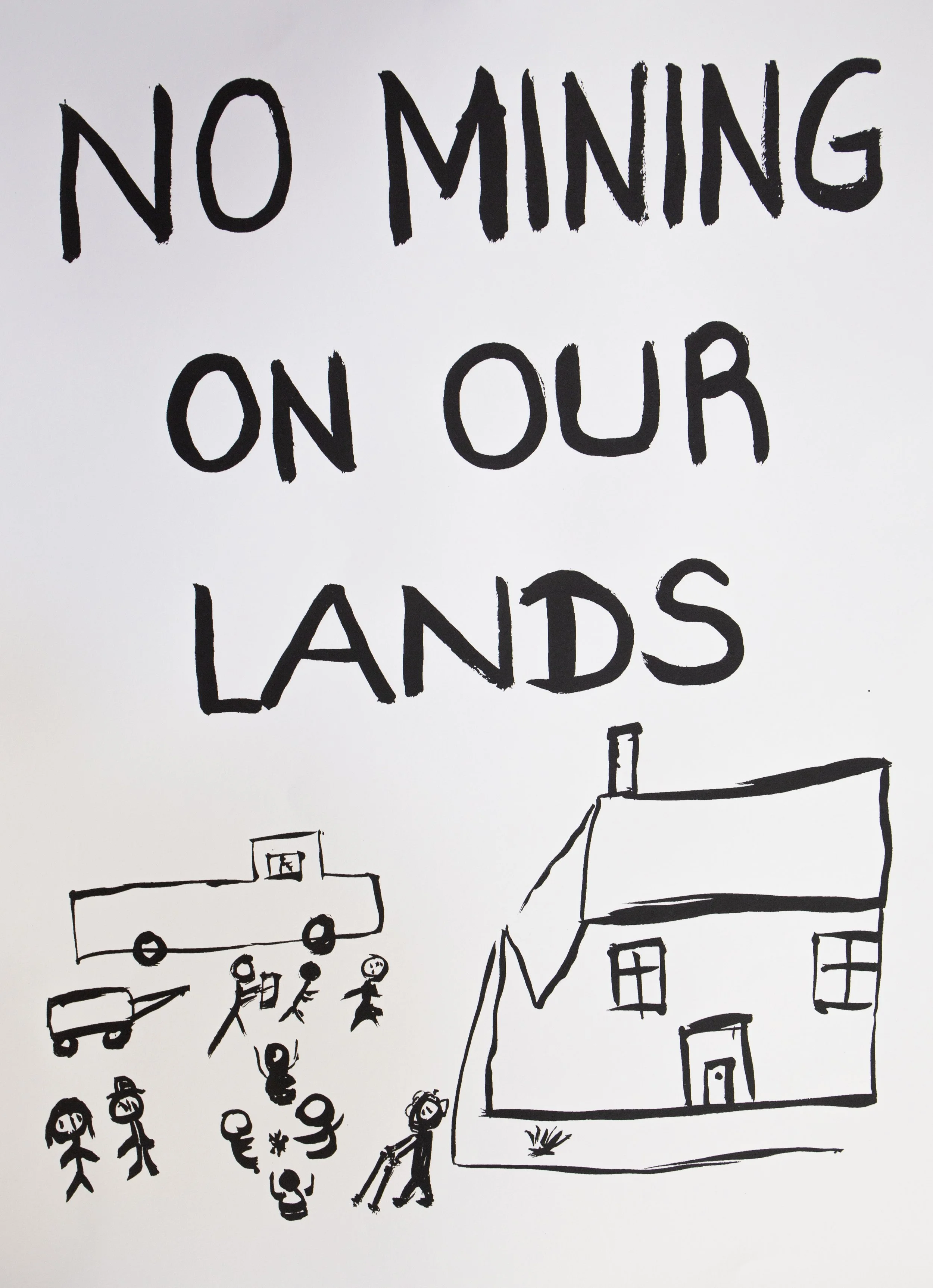
Stella McMillan / No Mining, 2023 #12932a-23-13/15
50 cm x 70 cm, 310gsm Magnani paper
Reprising the bold visual language of iconic 80s protest posters to speak to issues that face us today, these posters protest climate change and its impact on the desert. First Nations people are the first and will be the worst effected with fracking and the mismanagement of precious water resources - just two of many impending catastrophes.' Thea Perkins
$650 framed only
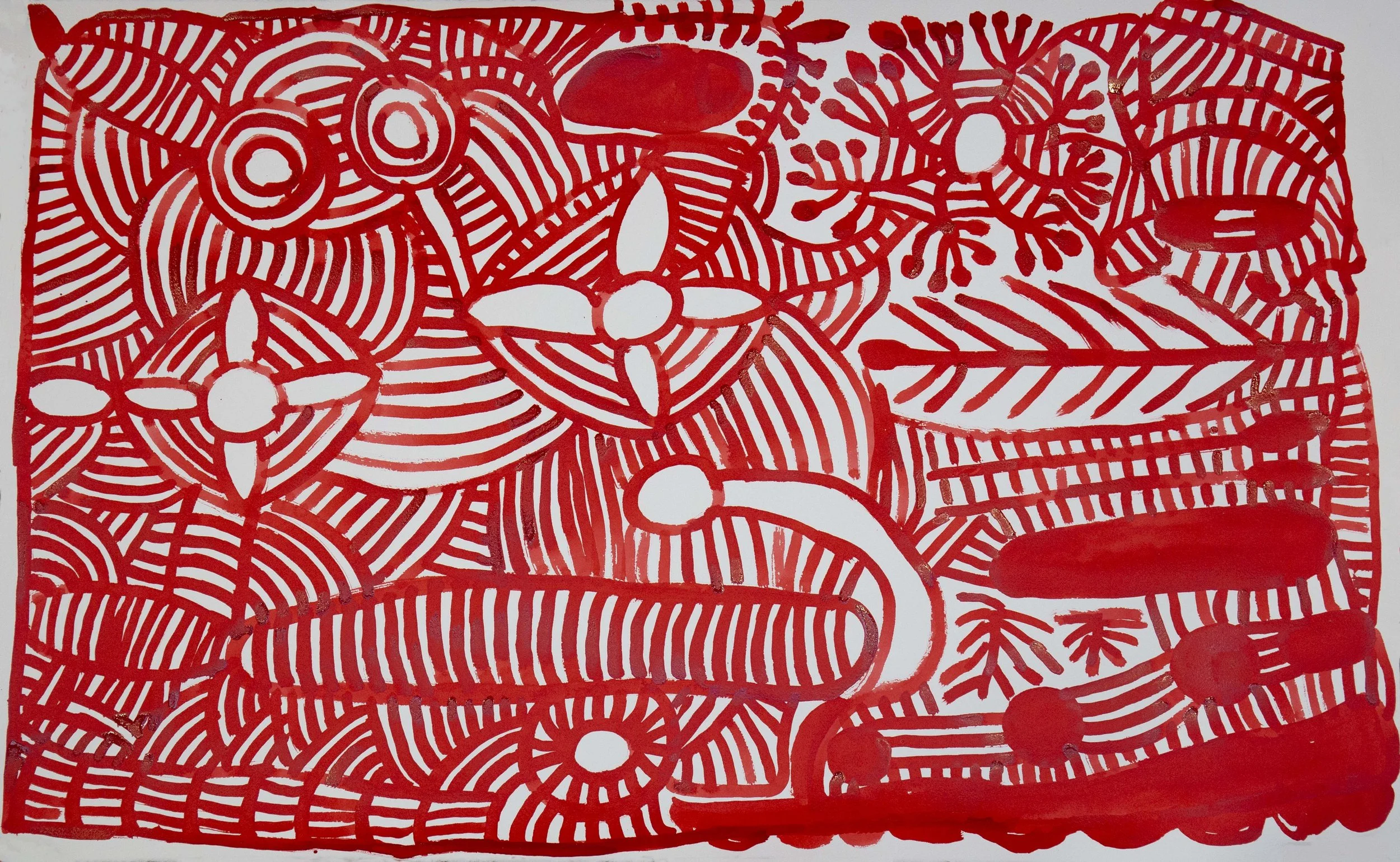
Doris Darinji Bush Nungarrayi / Bush Mangarri Tjuta, 2019 #10401-19
65.5 cm x 102 cm Ink on Archival Paper
Doris has painted a plentiful memory from her past in the early days when she was learning from her mother out at Wilura and Nyunmanu. Nyunmanu is a Dreaming site just to the south east of the remote Aboriginal community of Kintore in the Northern Territory. Doris talks of her and her mother handling different types of Mangarri [food]. As Doris talks about these memories she enacts the handling and eating of Mai [food] and drinking Kapi [water]. Doris speaks of breaking open Pura [big wild bush tomatoes] to eat the flesh and collecting and eating Ilyuru [a sweet natural cotton-candy-like bush food]. Doris talks of different tools to collect this Mangarri, like Wana [digging sticks], and speaks of other parts of the fruitful landscape such as Watiya [trees]. Now, when Doris sits to paint she sits under a large Watiya and remembers that this same type of Watiya was at Nyumanu too, and she and her mother would sit under it. Doris recalls the whole family sitting around Nikiti way [without clothes in the old days] and without any other Western tools. Doris explains 'Billy can wiya! Blanket wiya! Just running around!'.
$2060 framed only
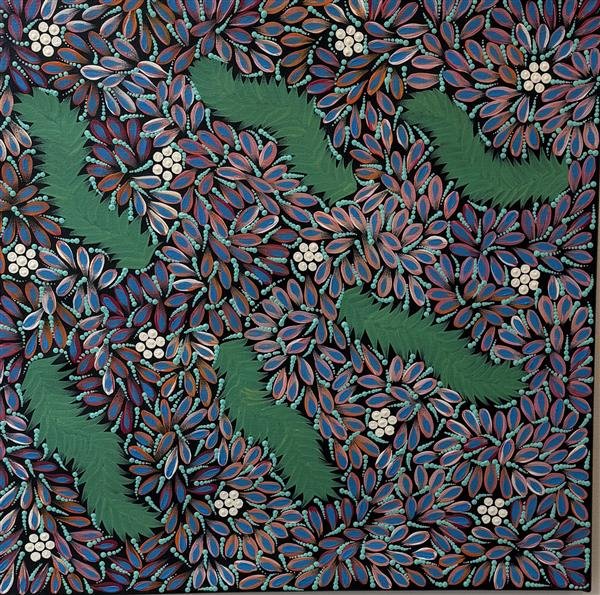
Christine Wirri / Irmangka Irmangka (Bush Medicine), 2025 #14270-25
61 cm x 61 cm Acrylic on Linen
Women collecting Irmangka Irmangka (Eremophila Alternifolia) bush medicine and making oil with it. To rub on your skin, good for sores and colds.
$520
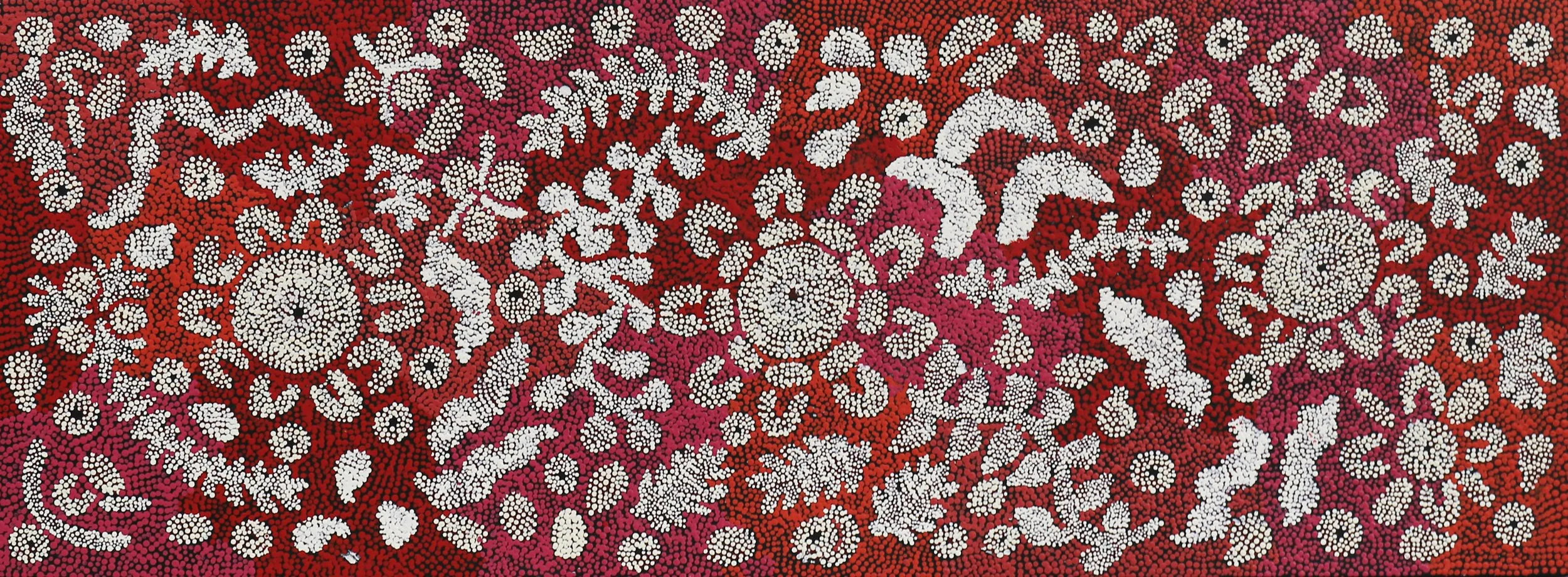
Rhonda Napanangka / Kapi Dreaming, Karrinyarra, 2025 #14272-25
44.5 cm x 122 cm Acrylic on Linen
'My grandfather’s country, my uncle’s country and my mother’s country. A waterhole ‘Waturlpunya’ in Karrinyarra and a chain of pointy hills, all within one country. I’ve been seeing those hills, part of that country. I only paint this one story. I depict all the woman sitting down, story telling. They’re here with their nulla nullas. This one is another waterhole, there’s lots of food here - bush tomato and other fruit. The women were looking for food that’s in abundance and have collected bush bean. They’ve lived off bush tucker for a long time. They’re sitting at the water’s edge resting after foraging for bush tucker. They’re watching the waterhole and digging for water, collecting it, stooped, with their heads down, seated on the ground. They’ve been living there in a big camp for a long time, in this distant place. A long time ago they camped in another place in Waturlpunyu … a long time before now, around another big waterhole in a water dreaming place. They camped there for some time before they grew up and spread out in many different directions moving to communities like Papunya. Papunya was close by, so they ended up staying there. That’s my uncle and that’s my mother. This is my father’s Tjukurrpa, and Grandfather’s hills in Karrinyarra.'
$900
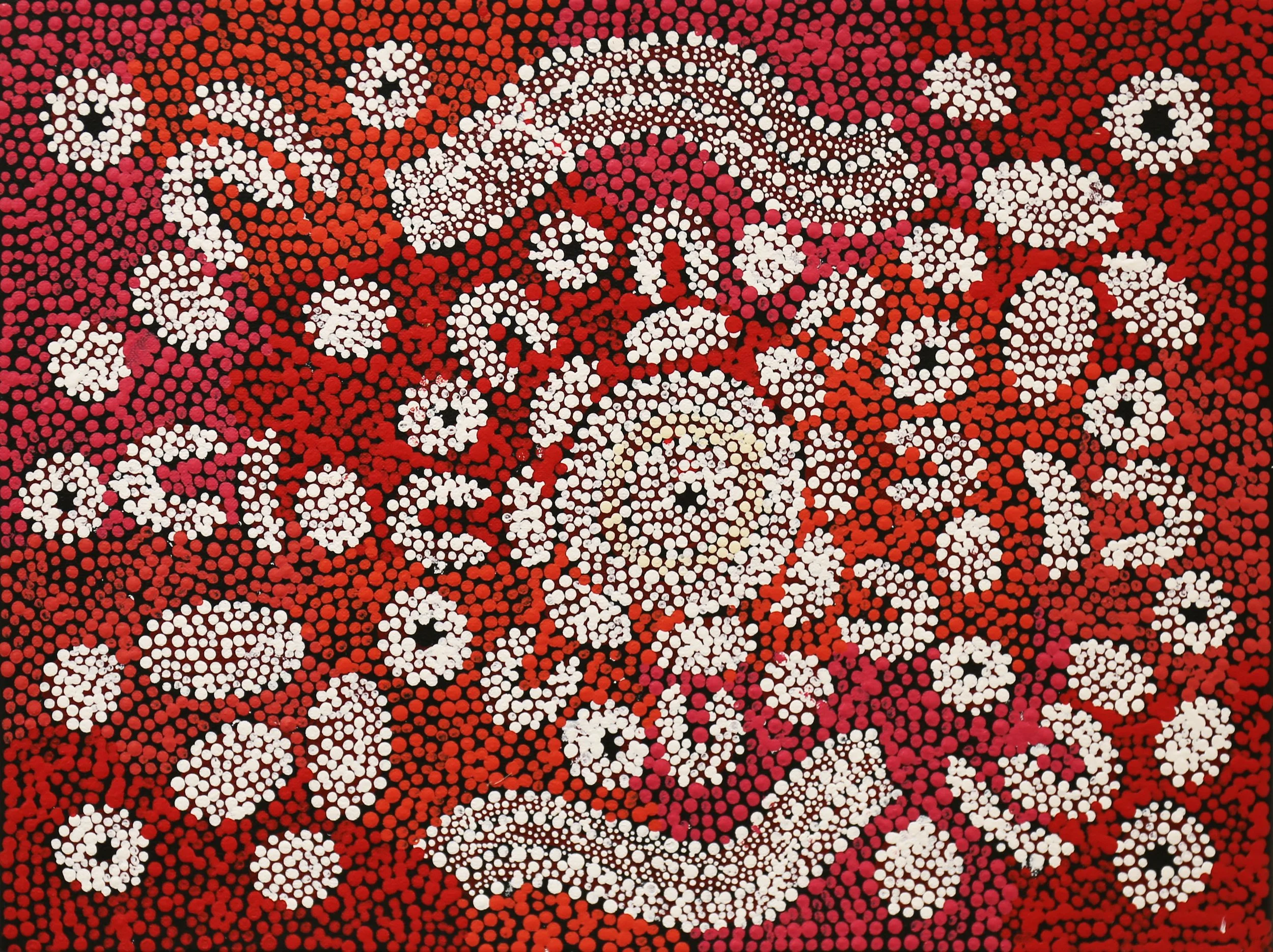
Rhonda Napanangka / Kapi Dreaming, Karrinyarra, 2025 #14282-25
30.5 cm x 41 cm Acrylic on Linen
'My grandfather’s country, my uncle’s country and my mother’s country. A waterhole ‘Waturlpunya’ in Karrinyarra and a chain of pointy hills, all within one country. I’ve been seeing those hills, part of that country. I only paint this one story. I depict all the woman sitting down, story telling. They’re here with their nulla nullas. This one is another waterhole, there’s lots of food here - bush tomato and other fruit. The women were looking for food that’s in abundance and have collected bush bean. They’ve lived off bush tucker for a long time. They’re sitting at the water’s edge resting after foraging for bush tucker. They’re watching the waterhole and digging for water, collecting it, stooped, with their heads down, seated on the ground. They’ve been living there in a big camp for a long time, in this distant place. A long time ago they camped in another place in Waturlpunyu … a long time before now, around another big waterhole in a water dreaming place. They camped there for some time before they grew up and spread out in many different directions moving to communities like Papunya. Papunya was close by, so they ended up staying there. That’s my uncle and that’s my mother. This is my father’s Tjukurrpa, and Grandfather’s hills in Karrinyarra.'
$250 on stretcher